
The Role of a Security Officer: Why Prevention Trumps Apprehension @GuardTrainingTN
When you picture a security officer, what comes to mind? For many, it's a reactive figure—someone who steps in to apprehend a shoplifter or respond to an alarm. While that's part of the job, it misses the true essence of their value. The most effective security professionals aren't just waiting for something to go wrong; they are actively working to ensure it never does.
Understanding the real role of a security officer is crucial for any business owner or property manager. It’s a shift in mindset from reaction to proaction, from apprehension to prevention. Under state guidelines such as the Tennessee Private Protective Services Licensing and Regulatory Act (T.C.A. § 62-35), a security service is legally defined as protecting persons and property, preventing unauthorized entry, and enforcing private property rules.
This article explores the core objectives of modern security, breaks down the critical differences between prevention and apprehension, and explains why a preventative strategy is the key to a safe environment.
The Core Mission: Understanding the Primary Objectives of Security
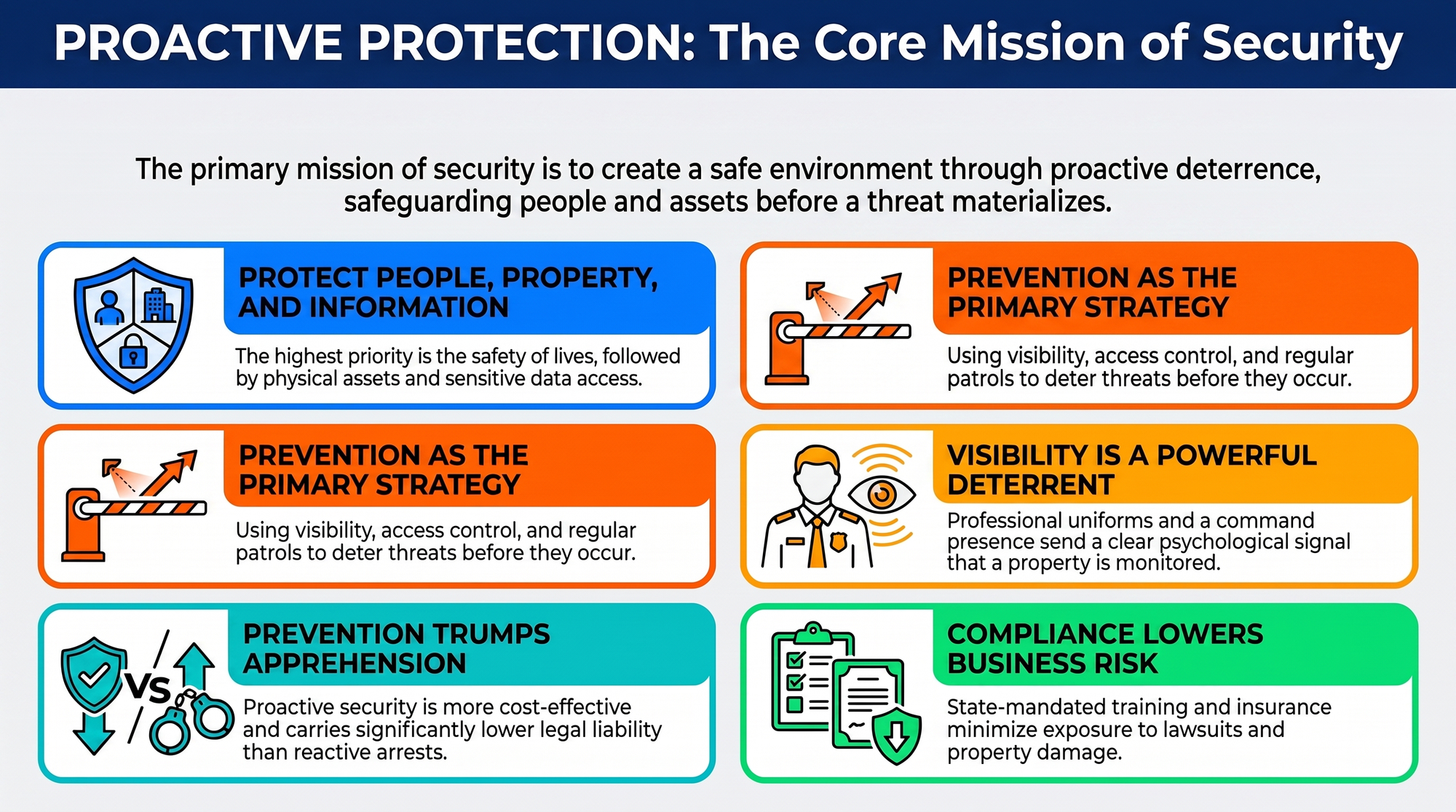
Before diving into specific duties, it's essential to understand the foundational goals that guide every action a security officer takes. Under T.C.A. § 62-35-102(18), security guard and patrol services exist primarily to safeguard private premises from criminal activities, vandalism, fire, and trespass. These objectives form a three-pronged approach to protection:
- Protect People: This is the highest priority. The safety and well-being of employees, customers, residents, and visitors are paramount.
- Protect Property: Safeguarding physical assets—from buildings and equipment to inventory and infrastructure—against theft, vandalism, and unauthorized intrusion.
- Protect Information & Access: Managing access control points to protect sensitive data, proprietary information, and restricted areas from unauthorized access.
These security objectives are best achieved not by catching culprits after the fact, but by creating an environment where incidents are unlikely to occur in the first place.
Prevention: The Proactive Heart of a Security Officer's Role
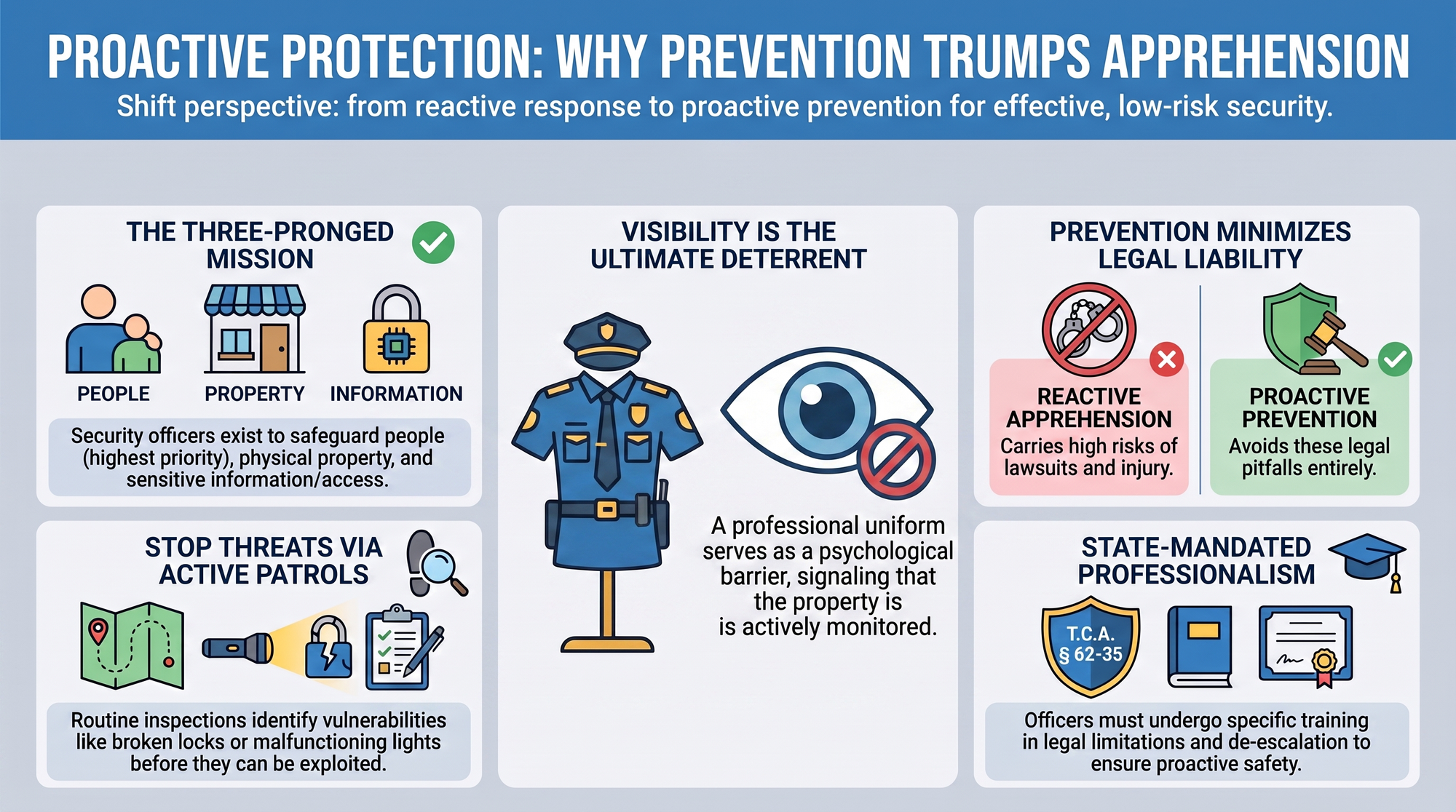
Prevention is the art and science of deterring threats before they materialize. A proactive security strategy centered on prevention is the most cost-effective and efficient way to maintain safety.
Visibility as a Deterrent
One of the most powerful tools in a security officer's arsenal is their uniform. Under Tennessee law (T.C.A. §§ 62-35-127 & 128), security uniforms and insignias must clearly identify private security guards and differentiate them from sworn law enforcement officers. A visible, professional command presence sends a clear psychological deterrent to potential wrongdoers: this property is actively monitored.
Access Control and Monitoring
Controlling who enters and exits a facility is a fundamental preventative measure. Security officer duties in this area include:
- Verifying credentials and IDs at entry points.
- Managing visitor sign-in and sign-out logs.
- Monitoring surveillance cameras (CCTV) for suspicious activity.
- Ensuring doors, windows, and perimeter access points remain secured.
Regular Patrols and Ongoing Inspections
Dynamic patrols keep security proactive rather than static. During patrols, officers actively assess the environment for physical vulnerabilities, such as broken locks, malfunctioning lighting, or propped-open fire doors. Correcting these hazards immediately eliminates opportunities for crime.
Apprehension: The Reactive, But Necessary, Function
While prevention is the primary goal, critical incidents can still occur. Apprehension is the reactive component of security—detaining an individual who has committed or is actively committing a crime on the property.
Legal Limitations and the Scope of Authority
A private security officer does not have the statutory authority of a sworn police officer. Under T.C.A. § 62-35-134(c), security personnel are explicitly prohibited from pretending to be or acting as sworn peace officers.
Apprehension is a last resort, reserved for clear-cut situations involving direct threats, theft, or assault. Because private security officers operate under specific legal limits (such as citizen's arrest statutes), improper detentions can expose businesses to severe legal liability.
To mitigate these risks:
- Mandatory State Training: Tennessee state law requires licensed security officers to undergo mandatory general training covering legal powers and limitations, emergency procedures, and general duties (T.C.A. § 62-35-118).
- De-Escalation Protocols: In high-risk commercial environments that serve alcohol, state regulations mandate specialized training in de-escalation and safe restraint techniques to resolve conflicts peacefully whenever possible.
Why Prevention is More Valuable Than Apprehension
Focusing on prevention vs. apprehension isn't just a philosophical choice; it’s a strategic business decision with tangible financial benefits:
- Lower Legal Liability: Attempted apprehensions increase the risk of physical injuries, property damage, and lawsuits. In fact, Tennessee law (T.C.A. § 62-35-114) requires licensed contract security companies to carry specialized general liability insurance covering false arrest, libel, slander, and personal injury. Focusing on prevention keeps these liability risks to a minimum.
- Cost-Effectiveness: Preventing a crime eliminates the heavy expenses of stolen inventory, property repair, business disruption, and insurance claims.
- Reputation Management: A high-profile crime or violent altercation harms a brand's public image. A visible preventative presence builds trust among clients, tenants, and staff.
- Better Workplace Morale: Employees thrive in environments where they feel safe and protected, leading to higher productivity and lower turnover.
Key Security Officer Duties That Support Prevention
The daily tasks of a trained security officer are structured around proactive risk mitigation:
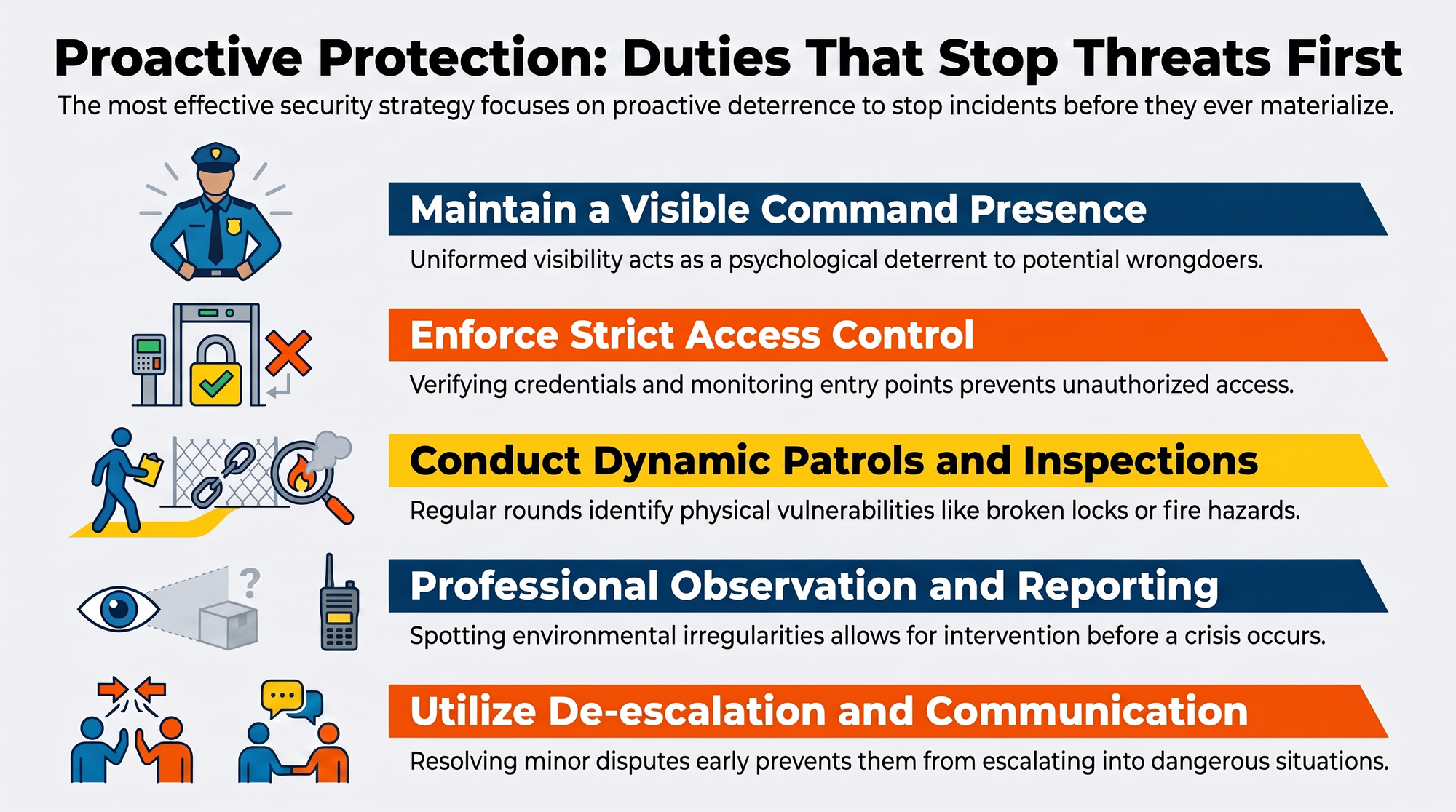
- Observation and Reporting: Officers are trained to spot irregularities, track baseline environmental changes, and produce objective incident reports.
- Emergency Preparedness: Security officers act as vital first responders during fires, medical emergencies, or severe weather, minimizing harm and safely guiding evacuations.
- De-escalation & Customer Service: As approachable points of contact, officers use communication skills to resolve minor disputes before they escalate into dangerous situations.
- Risk Assessment: Routine inspections allow officers to provide facility managers with actionable data to plug security gaps before bad actors exploit them.
Conclusion
The true role of a security officer is that of a guardian, not a law enforcement officer or chaser. Their value is measured not by how many arrests take place on your property, but by how many incidents are successfully prevented from ever happening.
By investing in professionally trained, state-compliant security personnel who prioritize visibility, access control, and proactive deterrence, you create a robust shield around your personnel, assets, and business reputation.
Call to Action
Ready to enhance your property's safety with a proactive security strategy? Contact our team today and discover how our state-certified security officers can safeguard your assets.
Frequently Asked Questions
What is the main difference between prevention and apprehension in security?
Prevention involves proactive measures—such as visible patrols, access control, and hazard checks—to stop incidents before they occur. Apprehension is a reactive response focused on detaining someone after an illegal act has occurred. Prevention is always the safer, more cost-effective strategy.
Are security officers in Tennessee allowed to make arrests?
Security officers operate under private property authority and statutory limits, such as citizen's arrest laws. They do not possess police arrest powers and are legally required under T.C.A. § 62-35-134(c) to avoid acting as sworn peace officers. Their focus is to secure the scene, protect lives, and detain individuals only when legally warranted until law enforcement arrives.
What training is required for security officers?
In Tennessee, security officers must complete state-mandated training under T.C.A. § 62-35-118. General training includes legal powers and limitations, emergency protocols, orientation, and general duties. Specialized posts (such as establishments serving alcohol or educational venues) require additional training in de-escalation, safe restraint, CPR, First Aid, or active shooter response.
Why is a visible security presence so effective?
Visible uniforms, designated vehicles, and active foot patrols serve as psychological deterrents. Potential bad actors weigh the risk of detection against the reward; a visible, professional guard presence signals that the property is monitored, prompting individuals to leave the area.
How Proactive Security Lowers Liability for Your Business @GuardTrainingTN