
Master the Security Guard Chain of Command 🛡️ | Alliance Training & Testing @guardtrainingtn
An angry visitor demands access to a restricted area in the main lobby, and a fire alarm triggers in an adjacent building. It's 2:00 AM, and this specific double-threat isn't in your post orders. Who do you call first?
In moments of high stress, you don't have time to guess. This is where a clear understanding of the security guard chain of command becomes your most valuable tool. Navigating this hierarchy is about much more than knowing who signs your paycheck—it's a framework designed for rapid response, absolute safety, and clear communication.
This guide demystifies the chain of command by explaining where your authority comes from, the key players involved, the differences between contracted and in-house operations, and why mastering this structure is crucial to the safety of the site you protect.
The Source of Your Authority: The Client
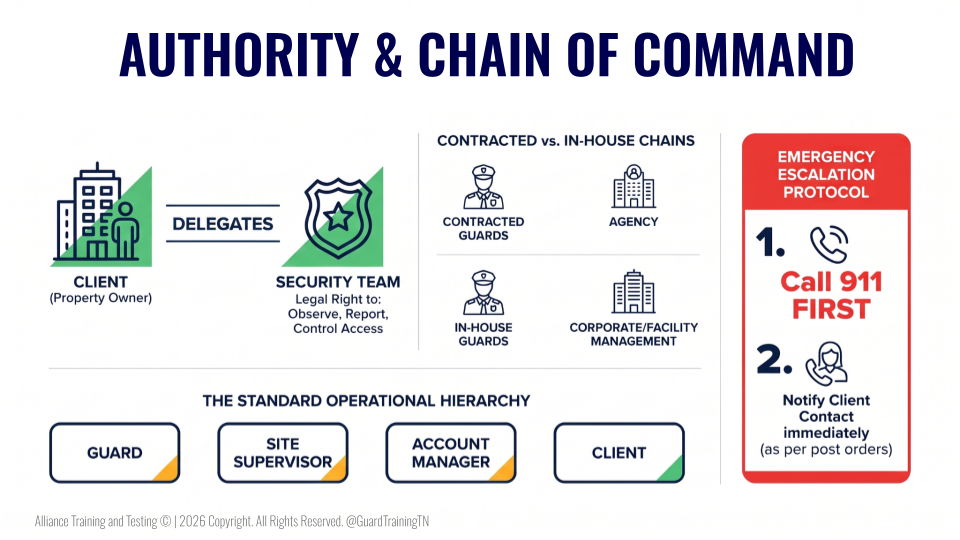
Before understanding the hierarchy, you must understand the foundation of your role: a security guard's authority comes directly from the client.
Whether you work for a massive security agency or directly for a local business, the legal right to observe, report, control access, and enforce rules on a specific property originates from the property owner or their designated management (the client). They delegate this authority to the security team. Understanding this dynamic matters because it shapes how site protocols are written and why certain emergencies require immediate client notification.
In-House vs. Contracted Security: How the Chain Changes
Your chain of command will look very different depending on your employment model.
Contracted Security Operations
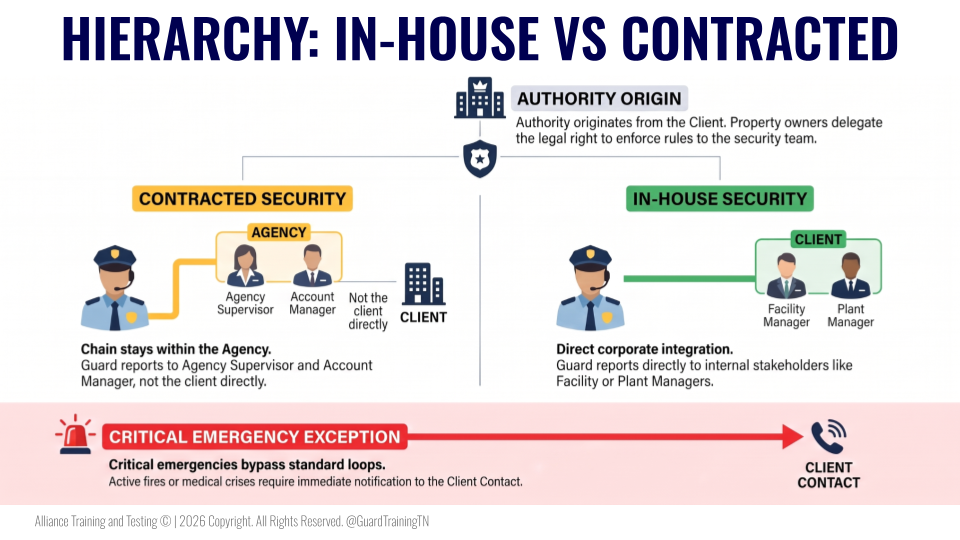
In this model, you work for a private security vendor (the agency), which a separate business (the client) hires to protect its property.
- The Chain: Guard > Agency Site Supervisor > Agency Account/Operations Manager.
- The Dynamic: Your chain of command is entirely within your security agency. While the client sets the ultimate goals and grants your authority, your agency supervisors provide day-to-day operational instructions and handle disciplinary actions. Client requests must typically go through your agency's management to protect against liability and ensure contract compliance.
In-House (Proprietary) Security Operations
In this model, you are employed directly by the business or organization whose property you are protecting (e.g., a hospital, a university, or a large corporation).
- The Chain: Guard > Shift Supervisor > Corporate Security Manager / Facility Manager.
- The Dynamic: The client and your employer are the same entity. There is no middleman agency. Your chain of command integrates directly into the organization’s corporate structure, meaning you will often report directly to internal stakeholders like a Plant Manager or Data Center Manager.
The Key Players: Who's Who in the Hierarchy?
The Security Guard (The Front Line)
As a security guard, you are the foundation of the entire structure. You are the eyes and ears on the ground, responsible for carrying out the daily tasks outlined in your site security protocols.
Your primary responsibilities include:
- Following post orders meticulously.
- Reporting all incidents, observations, and unusual activities to your immediate supervisor.
- Serving as the first point of contact for employees, visitors, and the public.
- Maintaining a professional demeanor at all times.
The Site Supervisor / Lead Officer
Your direct link in the chain of command is the Site Supervisor. This experienced officer oversees a specific shift or a small team at a single location.
Key security supervisor roles include:
- Providing clear instructions and guidance to guards.
- Ensuring all officers understand and adhere to site protocols.
- Handling initial incident escalation and on-site problem-solving.
- Compiling daily activity reports (DARs) from the team and passing them up the chain.
- Conducting on-the-job training and performance coaching.
The Account Manager / Operations Manager (For Contracted Operations)
If you work for a security agency, the Account Manager oversees multiple sites or a large, complex client account.
Their responsibilities involve:
- Developing and updating post orders in collaboration with the client.
- Managing scheduling, payroll, and staffing.
- Addressing high-level security issues.
- Acting as the main liaison between the security company and the client.
The Client Contact (Corporate Security Manager, Facility Manager, etc.)
Depending on the site, the primary "Client Contact" might be the Corporate Security Manager, Facility Manager, Plant Manager, or Data Center Manager.
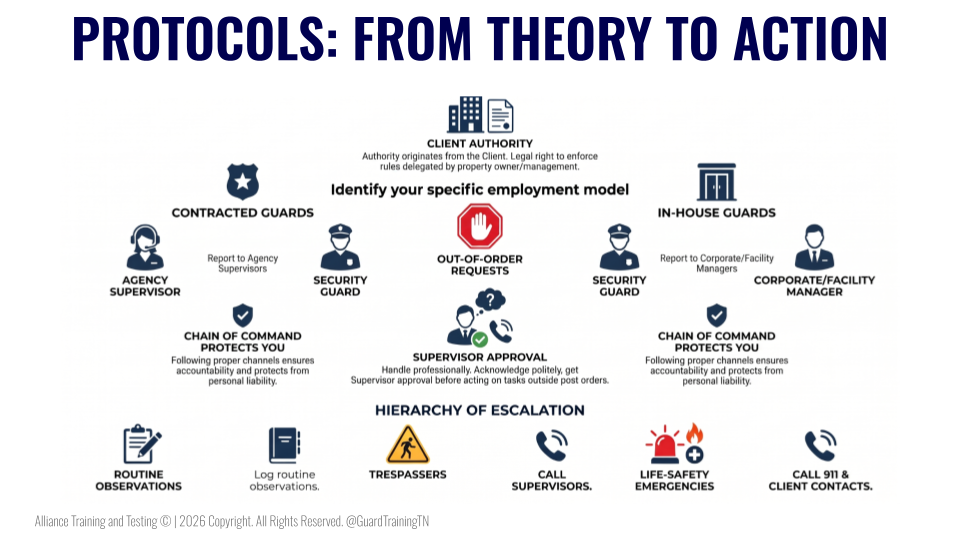
In contracted security, direct standard client requests through your agency supervisor. If a client asks you to do a task outside your post orders, politely acknowledge the request and inform your supervisor for guidance.
However, critical exceptions require direct client contact. For major facility emergencies—such as an active fire, a severe medical incident, or a major security breach—your post orders will often require you to notify the designated Client Contact directly and immediately after dialing 911. The Facility Manager or Corporate Security Manager needs real-time awareness to execute internal emergency procedures.
Why Following the Chain of Command is Non-Negotiable
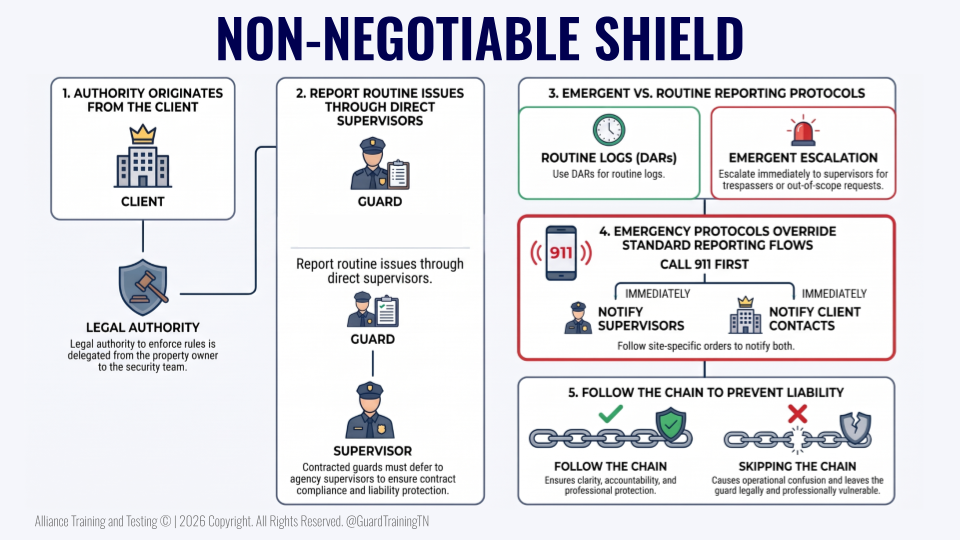
Adhering to the chain of command is a fundamental principle of professional security work.
- Clarity and Order: It prevents confusion by ensuring information flows through the proper channels.
- Accountability: It establishes a clear record of who reported what to whom, which is critical for incident reviews and liability.
- Efficiency: Supervisors can handle most on-site issues, freeing senior management to focus on larger operational matters.
- Your Protection: Following the chain ensures you act under your superiors' direction, protecting you from liability.
Navigating Security Site Protocols: Putting Theory into Practice
Your security site protocols, found in your post orders, are the playbook for your role. The chain of command is the system you use to execute that playbook effectively.
Below is a quick reference for common scenarios:
- Routine observation (e.g., burnt-out light, unlocked interior door): No immediate call is required; simply log this in your DAR for the end-of-shift report.
- Client asks for a task outside post orders (Contracted): Acknowledge the client politely, but call your Site Supervisor for approval before acting.
- Trespasser refusing to leave: Call your Site Supervisor immediately for backup and guidance.
- Active fire, medical emergency, or violent threat: Call 911 first. Because emergency contact procedures vary significantly from site to site, you must strictly follow your post orders on who to notify next—this often means immediately alerting both your chain of command and the direct Client Contact (like the Facility Manager).
To ensure you apply these correctly:
- Know Your Orders: First, read and understand your post orders. They detail your specific emergency procedures.
- Identify Your Supervisor: On your first day, know who your direct supervisor is and how to contact them.
- Practice Reporting: Use the "who, what, when, where, why" method for clear reporting.
- Understand Escalation: Your post orders define what constitutes a routine report versus an emergency.
Conclusion
The security guard chain of command ensures clear communication, promotes safety, and establishes professional accountability. By understanding that your authority stems from the client, recognizing the differences in your specific employment model, and knowing your site-specific emergency protocols, you move from a simple observer to a vital part of a coordinated security solution.
Frequently Asked Questions
1. What happens if I skip the chain of command? Skipping the chain of command can cause significant confusion, delay responses, and may be viewed as insubordination. Always report to your immediate superior unless they are unavailable in a true emergency, or your post orders explicitly require you to contact a client representative directly.
2. Who is more important to listen to: my supervisor or the client? If you are in contracted security, your direct supervisor is your primary operational authority. While you must always respect the client (as they grant your authority on-site), their requests should not override your agency's protocols. Politely defer to your supervisor to resolve conflicting instructions. If you are in-house security, the client management is your direct chain of command.
3. How does the chain of command work in an emergency? In a true emergency, your first priority is to follow the specific emergency procedures in your post orders, which almost always begins with notifying emergency services (911). Because emergency contact procedures vary by site, your post orders will dictate exactly who to call next—whether it is your agency supervisor, the on-site Facility Manager, or a Corporate Security Manager.
4. Is the chain of command the same at every security site? No. While the basic concept remains, the structure changes heavily depending on whether the security team is in-house or contracted. Large corporate campuses may have complex structures involving site commanders and multiple shift supervisors, while a small retail site may have only a single guard and a mobile supervisor.
Security Guard Chain of Command Shield: Your Ultimate Legal Defense | @guardtrainingtn