
The final 15 minutes of a security guard's shift can be the most critical window of their entire duty cycle. A rushed or incomplete handover leaves a site vulnerable, potentially undoing hours of diligent monitoring and asset protection. Imagine a critical piece of intelligence—a suspicious vehicle circling the perimeter or a temporarily disabled access control door—getting lost in a hurried exchange. The incoming guard is left unaware, a potential threat goes unmonitored, and the client's property is exposed. This significant operational risk stems directly from a poor shift transition.
Master the Security Guard Shift Changeover @guardtrainingtn 🛡️ 4 Steps to Secure Handovers
Mastering the security guard shift handover is a core competency that underpins the entire security operation. A seamless transition ensures continuity, enhances site safety, reduces legal liability, and demonstrates professionalism to clients and stakeholders.
This guide provides a comprehensive framework for conducting flawless shift handovers. By standardizing the process, leveraging the security pass-down log, and implementing advanced communication strategies, security professionals can ensure continuous, uncompromised protection.
Why an Effective Shift Handover is Crucial in Security
A weak link in the shift-change chain can have severe consequences, from minor property damage to critical safety breaches. The primary goal is to ensure the incoming guard possesses the exact same level of situational awareness as the outgoing guard.
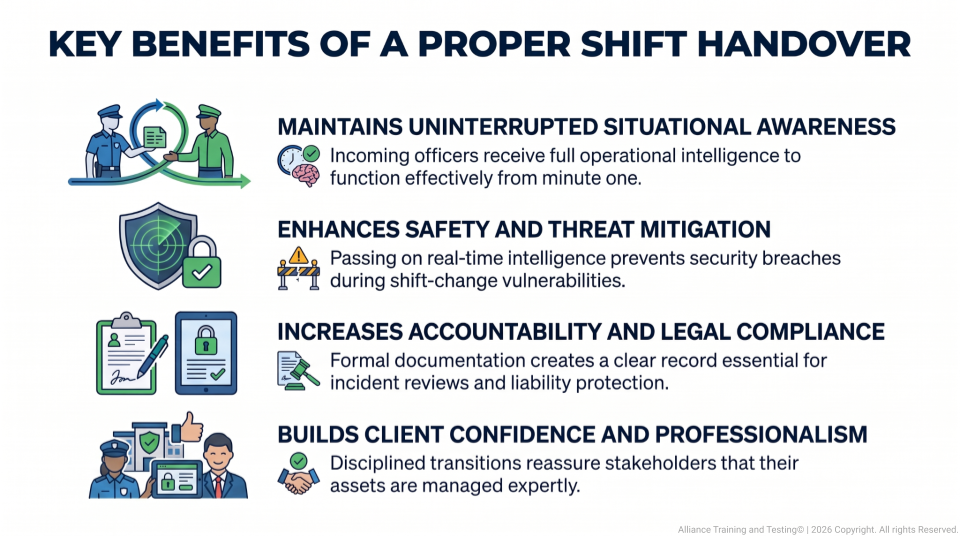
Key benefits of a proper handover include:
- Uninterrupted Situational Awareness: The incoming officer receives a complete picture of all recent activities, behavioral observations, and potential risks, allowing them to operate at full capacity from minute one.
- Enhanced Safety and Threat Mitigation: By passing on critical intelligence, the process continuously monitors potential threats. This prevents security breaches that typically exploit the "blind spot" created by a disorganized handover.
- Increased Accountability and Compliance: A formal process, documented in a legally sound log, creates a clear record of what information was transferred, by whom, and at what exact time. This is invaluable for incident reviews, insurance claims, and liability protection.
- Client Confidence and Professionalism: A smooth, thorough, effective shift transition reflects positively on the security team. Clients who witness disciplined, structured handovers trust that their assets are in capable hands.
The Anatomy of a Perfect Security Guard Shift Handover
A perfect handover is a highly structured protocol, not a casual conversation. It must be a mandatory, non-negotiable phase of every shift change. Standardizing these four steps ensures no information is lost.
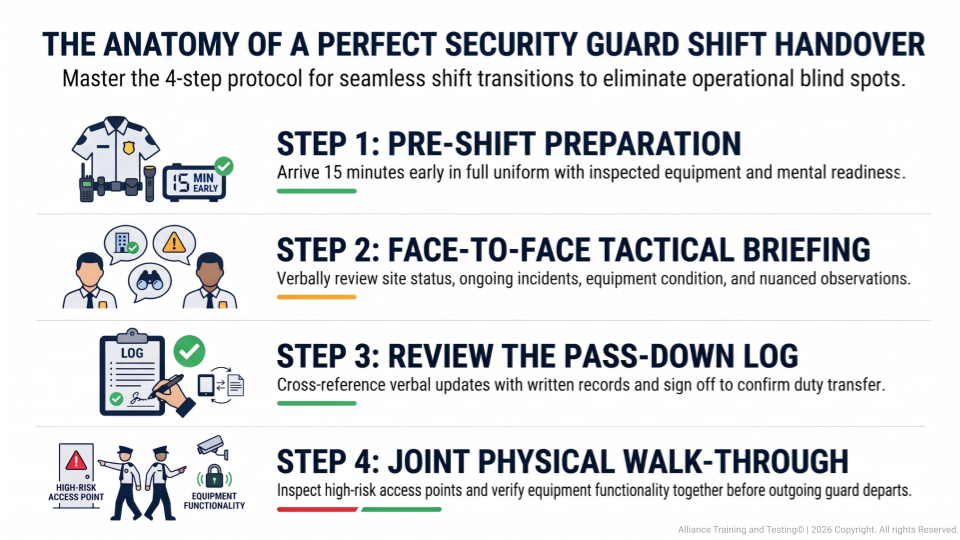
Step 1: Pre-Shift Preparation (The Incoming Guard)
The handover begins before the outgoing guard arrives. Incoming officers set the tone for the transition.
- Arrive with Buffer Time: Arrive at least 15 minutes before the shift officially starts. This provides ample time for a thorough briefing, equipment checks, and uniform adjustments without cutting into active patrol time.
- Operational Readiness: Arrive in full uniform with all necessary equipment (two-way radio, flashlight, tactical gear, notepad, and pen) inspected and ready to deploy.
- Mental Clarity: Transitioning into a security mindset requires leaving personal distractions behind. Approach the handover ready to actively listen and absorb critical site intelligence.
Step 2: The Face-to-Face Tactical Briefing
Verbal communication with the security guard allows nuance, tone, and immediate clarification that a written log alone cannot convey.
Key discussion points must include:
- Current Site Status: Is the site operating normally, or are there active deviations (e.g., severe weather protocols, power outages)?
- Ongoing Incidents: Detail any situations that remain active, such as a loiterer refusing to leave the perimeter or an ongoing maintenance issue.
- Significant Shift Events: Brief the incoming guard on any triggered alarms, perimeter breaches, identified safety hazards, or documented unusual activity.
- Equipment and Asset Check: Physically confirm the operational status of critical equipment: CCTV monitors, access control panels, radios, master keys, and patrol vehicles. Note any malfunctions or ongoing repairs.
- Special Directives: Relay any temporary post orders, management directives, or specific client requests issued during the previous shift.
- Nuanced Observations: Share gut instincts or subtle anomalies—a regular contractor acting unusually, a vehicle parked slightly out of bounds, or an access door that requires extra force to latch completely.
Step 3: Reviewing the Security Pass-Down Log
The verbal briefing must be corroborated by a formal written record. The incoming guard must read and comprehend the latest entries in the security pass-down log or Daily Activity Report (DAR).
- Cross-reference the verbal briefing against the written documentation to ensure consistency.
- Ask targeted questions to clarify any vague or ambiguous entries.
- Formally acknowledge the transfer of duty by signing or initialing the log beneath the outgoing guard's final entry.
Step 4: The Physical Walk-Through (Where Applicable)
Whenever site protocols and staffing levels permit, a joint physical patrol is highly recommended. This lets the outgoing guard point out areas of concern, demonstrate equipment malfunctions, and verify that high-risk access points are secure before leaving.
The Heart of the Handover: The Security Pass-Down Log
The security pass-down log is the continuous historical record of a security post. It is a legal document that can be subpoenaed in court. A meticulously maintained log is a security professional’s strongest defense and most vital tool.
Essential Pass-Down Log Elements
Every entry must provide actionable value to the next officer. Use the following structured format to ensure completeness:
- Officer Details: Name, badge number, and rank of the officer on duty.
- Best Practice Standard: Print credentials clearly at the start of the shift and at the final handover entry.
- Chronological Timestamps: Date of the shift and the exact time of each entry.
- Best Practice Standard: Utilize a 24-hour military time format (e.g., 1400 hrs) to prevent AM/PM confusion.
- Routine Patrols: Start and end times of all foot or vehicle patrols.
- Best Practice Standard: Note the specific route taken and confirm that all checkpoints were secure ("All secure" or "Code 4").
- Incidents & Responses: Detailed accounts of alarms, unauthorized access, medical emergencies, or rule violations.
- Best Practice Standard: Stick strictly to objective facts. State actions taken, authorities contacted, and resolution status.
- Equipment Status: Condition of radios, cameras, gates, and vehicles.
- Best Practice Standard: Immediately log any damaged or malfunctioning equipment to avoid liability for prior damage.
- Access Control: Arrivals and departures of non-employees, contractors, or VIPs.
- Best Practice Standard: Record name, company, vehicle license plate, time in/out, and authorizing party.
- Pass-On Directives: A dedicated section for specific instructions for the incoming shift.
- Best Practice Standard: Highlight or underline critical pass-ons so they cannot be missed during a quick scan.
- Handover Confirmation: Final entry confirming the transfer of authority.
- Best Practice Standard: Must include the signatures/initials of both the outgoing and incoming officers.
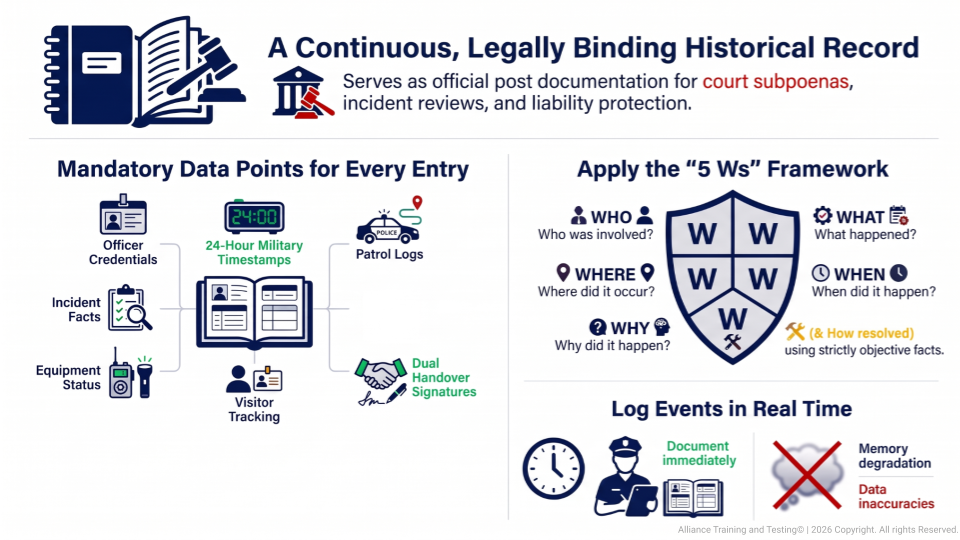
Best Practices for Writing Bulletproof Log Entries
- Absolute Objectivity: Report exclusively what you saw, heard, smelled, or did. Avoid subjective opinions, assumptions, or emotional language. (Write "The individual smelled of alcohol and was swaying," not "The guy was completely drunk.")
- Professional Clarity: Avoid obscure slang, informal jargon, or overly complex syntax. Write so that a judge, a client, or a newly hired guard can easily understand the entry.
- Real-Time Documentation: Log events immediately as they occur, or as soon as the scene is safe. Memory degrades quickly; delayed logging leads to inaccuracies.
- The "5 Ws" Framework: Ensure every significant entry answers Who, What, Where, When, and Why (if known), followed by How it was resolved.
Common Mistakes to Avoid During Shift Transitions
Even veteran guards can become complacent. Security supervisors should monitor handovers to ensure these common pitfalls are avoided:
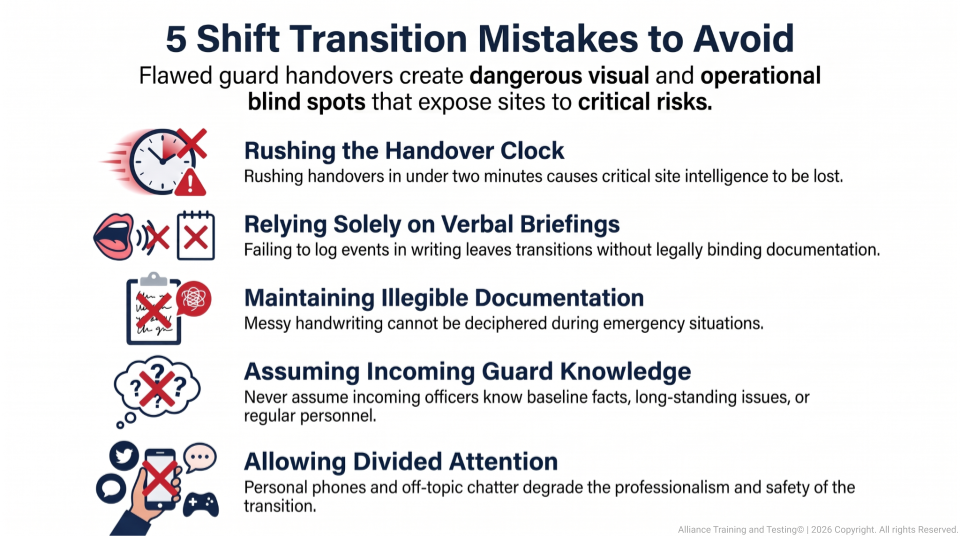
- Rushing the Clock: Attempting to complete a handover in two minutes as the outgoing guard heads for the door is the leading cause of critical intelligence loss.
- The "Verbal Only" Trap: Relying entirely on memory and verbal exchange is dangerous. In the security industry, if an incident or directive isn't documented in the log, it didn't happen.
- Illegible Documentation: A handwritten log that cannot be deciphered during an emergency is useless. Officers must prioritize neat, legible handwriting, or utilize digital reporting software.
- Assuming Knowledge: Never assume the incoming guard knows about a long-standing issue or recognizes a regular contractor. Communicate all baseline facts clearly.
- Divided Attention: Taking personal phone calls, scrolling through social media, or engaging in off-topic banter during the briefing degrades the professionalism and efficacy of the transition.
A security guard shift handover is far more than an administrative routine; it is a fundamental pillar of a robust physical security strategy. It is the moment when a facility's safety, assets, and personnel hang in the balance of communication. By implementing a standardized briefing protocol and meticulously maintaining the security pass-down log, security teams guarantee an effective shift transition. Committing to this level of structured security guard communication protects the client, fortifies the site, and elevates the professional standard of the entire security operation.
Frequently Asked Questions
1. What is the primary purpose of a security pass-down log? The primary purpose of a security pass-down log (or Daily Activity Report) is to provide a continuous, chronological, and legally binding record of all activities, incidents, and observations at a security post. It ensures incoming guards have complete situational awareness and provides management and clients with an official record for accountability and liability protection.
2. How long should a security shift handover take? A thorough security shift handover should take 10 to 15 minutes. This timeframe allows for a detailed verbal briefing, a review of the pass-down log, an equipment inventory check, and time for the incoming officer to ask clarifying questions without rushing.
3. What's the difference between a pass-down log and an incident report? A pass-down log is a running, chronological summary of all routine and non-routine activities during a shift. An incident report is a separate, highly detailed document created for a specific, significant event (e.g., theft, assault, severe property damage, or emergency response). The pass-down log will briefly note that the event occurred and reference the specific incident report filed.
4. Can a shift handover be done digitally or over the phone? While digital guard tour systems and communication apps greatly enhance logging, they should supplement—not replace—a face-to-face briefing whenever possible. Direct conversation conveys nuance and enables immediate Q&A. Reserve phone handovers for emergencies, single-guard posts where shifts don't overlap, or remote sites where physical handovers are geographically impossible.
🛡️ Bulletproof Security Guard Shift Handovers @guardtrainingtn | Tactical Protocols & Liability