
Mastering Tactical Situational Awareness - Security Officer Training @GuardTrainingTN
As a security professional, your primary weapon isn't on your duty belt—it’s your mind. While the general public can afford to walk through a crowded lobby distracted by their smartphones or lost in thought, a security guard does not have that luxury. In the security industry, the difference between a minor incident and a major crisis often comes down to a few crucial seconds of early detection.
This is the absolute power of situational awareness. It is the tactical difference between simply looking at your post and truly seeing the environment you are sworn to protect.
This comprehensive training guide provides actionable situational awareness techniques designed specifically for security personnel. You will learn how to systematically scan any environment, establish critical baselines, and spot anomalies instantly. By mastering these concepts, you will dramatically enhance your operational readiness, ensuring the safety of your site, your clients, and yourself.
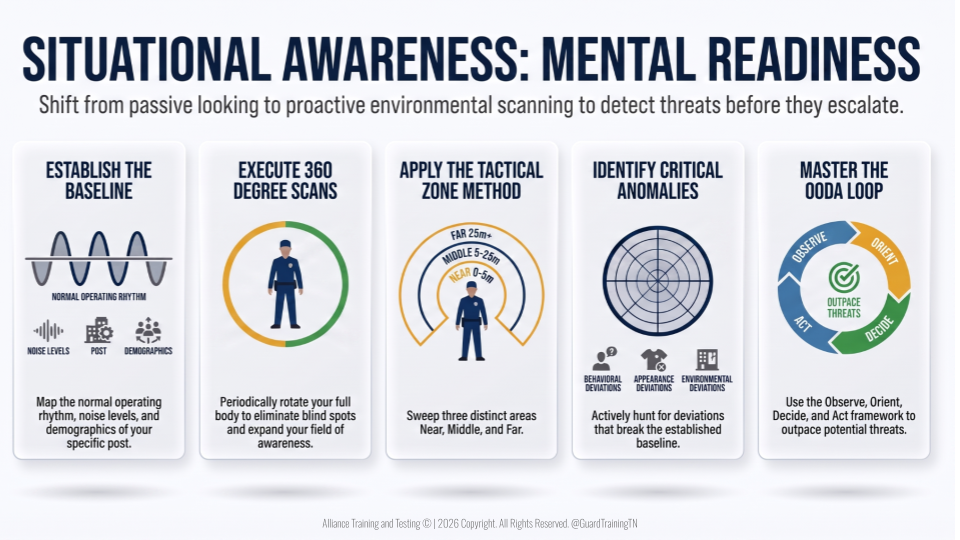
What is Situational Awareness in Private Security?
At its tactical core, situational awareness is the ability to identify, process, and understand critical information about what is happening around you. For a security guard, it means maintaining a continuous, active understanding of your operational environment.
This is not about paranoia; it is about professional presence and proactive engagement. Improving observation skills is the foundational step toward making rapid, accurate decisions under pressure—whether you are patrolling an industrial site at 2:00 AM, managing crowd control at an event, or monitoring a corporate access point.
The professional benefits of mastering this skill include:
- Proactive Threat Mitigation: Identifying and neutralizing potential threats before they escalate into physical altercations or property damage.
- Superior Decision-Making: Armed with accurate, real-time environmental data, you can choose the correct tactical response and deploy resources effectively.
- Command Presence: Security officers who are highly attuned to their surroundings naturally project confidence and authority, which acts as a powerful deterrent to criminal behavior.
The Foundation of Security: Establishing a Baseline
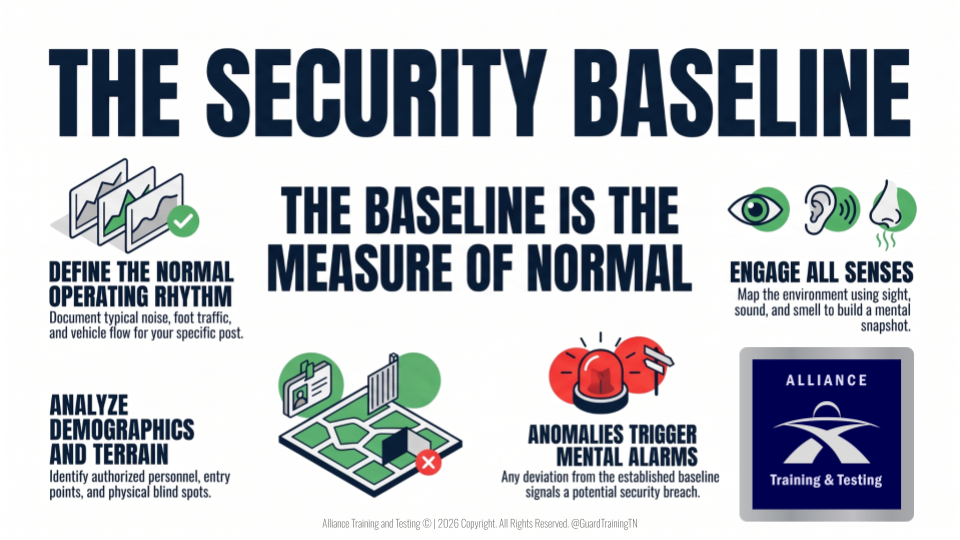
Before you can spot a threat, you must first understand what is normal. In security terminology, this "normal" state is known as a baseline.
Think of the baseline as the standard operating rhythm of your patrol area. It dictates the typical noise levels, the flow of foot traffic, the type of vehicles present, and the general demeanor of the people on-site. For example, the baseline of a hospital emergency room waiting area on a Saturday night is vastly different from the baseline of a corporate office building on a Sunday morning.
Your goal as an elite security officer is to map this out consciously. By actively observing and documenting your site's expected baseline behavior, you give yourself a massive tactical advantage. Any deviation from this baseline—an anomaly—will trigger an immediate mental alarm.
How to Establish a Baseline on Duty
Establishing a reliable baseline requires engaging all your senses to build a dynamic mental snapshot of your post. Whenever you start a shift or enter a new zone, run through this checklist:
- Engage All Senses: Do not rely solely on your vision. What do you hear (machinery running, normal conversation volumes, traffic)? What do you smell (normal building odors vs. smoke, chemicals, or alcohol)?
- Analyze the Demographics: Who is authorized to be here? Are they wearing badges, uniforms, or business attire? Are they moving purposefully toward elevators, or are they loitering?
- Understand the Environmental Rhythm: How does the time of day affect your site? Is it the morning rush, a shift change, or after-hours?
- Map the Physical Terrain: Take a tactical inventory of your space. Where are the primary and secondary exits? Where are the blind spots, choke points, and potential areas of concealment? Where are the security cameras pointing?
Mastering Environmental Scanning Techniques
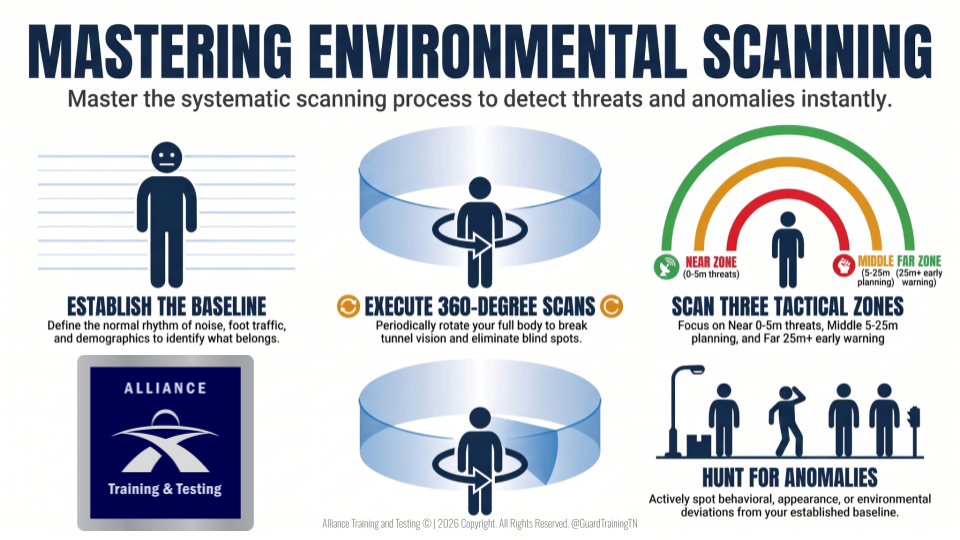
Once you understand the baseline, you must actively hunt for deviations. Effective environmental scanning is not a random, passive glance; it is a systematic, deliberate process of sweeping your focus to cover your entire area of responsibility.
Incorporate these three fundamental situational awareness techniques into your daily patrols and static guard duties.
1. The 360-Degree Scan
This is the most critical technique for a security guard. It involves breaking the natural habit of "tunnel vision" and making a conscious effort to assess the environment in a full circle.
Whether you are stepping out of a patrol vehicle, exiting an elevator, or just standing at a static post, periodically turn your head (and your body, if necessary) to observe your surroundings in a complete 360-degree radius. This immediately expands your field of awareness, ensuring no one can approach you from your blind spot without you noticing.
2. The Tactical Zone Method (Near, Middle, Far)
To avoid sensory overload in chaotic environments, break your visual sweep down into three distinct, manageable zones.
- Near Zone (0 to 5 meters): This is your immediate reactionary gap. Your scan here must be hyper-focused on anyone or anything that could present an instant, physical threat. Focus on people's hands (are they concealed?), their body language (are they blading their body away from you?), and sudden aggressive movements.
- Middle Zone (5 to 25 meters): This is your tactical planning zone. Here, you are looking for developing situations. Are groups forming? Is someone arguing? Are individuals displaying behavior that breaks from the facility's established baseline?
- Far Zone (25+ meters): This is your early warning system. You aren't looking for micro-expressions here; you are looking for macro-patterns. Is a vehicle circling the parking lot slowly? Is a crowd gathering at the perimeter gate? Spotting an issue in the far zone buys you time to call for backup or lock down a facility.
3. Hunting for Anomalies: What Doesn't Fit?
An anomaly is any deviation from the baseline. This is where your commitment to improving observation skills yields results.
Critical anomalies security guards must look for include:
- Behavioral Anomalies: An individual repeatedly walking past a secure access door, someone pacing nervously and sweating in a cool room, or an individual taking a high level of interest in security camera placements and guard patrol routes (surveillance).
- Appearance Anomalies: A person wearing a heavy, oversized coat in the middle of summer (potential weapon concealment), an individual wearing a uniform that doesn't quite match company standards, or someone trying to aggressively tailgate through a badge-access door.
- Environmental Anomalies: A normally locked door propped open with a rock, a vehicle parked directly in a fire lane or outside a loading dock, a sudden, unexplained silence in a typically noisy manufacturing area, or an unattended bag near an entrance.
Putting It All Together: A Scenario for Security Guards
Let's imagine you are posted at the front desk of a busy corporate high-rise lobby. Here is how you apply these principles in a real-world setting:
- Assume the Post (360-Degree Scan): As you relieve the previous guard, you do a full sweep of the lobby. You check the front doors, the elevator banks, and the seating area behind your desk.
- Assess the Baseline: It is 8:45 AM on a Tuesday. The baseline is high foot traffic. Employees wear business casual attire, swipe badges at the turnstiles, and move purposefully toward the elevators. The noise level is a steady hum of footsteps and brief greetings.
- Scan the Zones:
- Near Zone: You monitor the badge swipes directly in front of your desk, watching hands and ensuring no tailgating occurs.
- Middle Zone: You scan the people walking through the revolving doors. You monitor the seating area for anyone loitering.
- Far Zone: You look through the glass exterior doors to the street, watching for any unusual vehicles or aggressive individuals approaching the building.
- Identify the Anomaly: Amidst the rush of employees, you spot an individual in the Middle Zone. He is not moving toward the turnstiles. He wears a bulky jacket (despite the warm spring day) and lingers near a structural pillar, watching the badge-swiping process intently.
- Action: You have successfully identified a behavioral and appearance anomaly. You do not panic. You step out from behind the desk, maintain a safe reactionary distance, and initiate a professional "hard approach," greeting the individual with a firm, "Good morning, sir. Can I help you find who you are looking for?" You have just disrupted potential hostile surveillance or a breach attempt simply through superior observation.
Conclusion
Mastering situational awareness techniques transforms observation from a passive requirement into a proactive, tactical skill. By consciously practicing how to establish baselines and conduct disciplined environmental scanning, security professionals can detect, deter, and respond to incidents with unmatched efficiency.
Observation is a perishable skill. Practice these techniques daily, even when off-duty. Conscious commitment to improving observation skills is the hallmark of a true security professional, empowering you to command your environment and ensure the safety of everyone under your watch.
Frequently Asked Questions for Security Professionals
1. How do I maintain situational awareness during a long, 12-hour shift? Fatigue is the enemy of awareness. To combat this, avoid staring blankly at one spot. Rotate your scanning techniques (switch between the 360-degree scan and the Zone Method). Stay hydrated, maintain good posture, and if you are at a static post, make micro-movements to keep your blood flowing. When your attention starts to slip, consciously force yourself to find three new details in your environment.
2. What is the OODA Loop, and how does it apply to security guards? The OODA Loop (Observe, Orient, Decide, Act) is a tactical decision-making framework. Situational awareness represents the crucial "Observe" and "Orient" phases. By rapidly observing an anomaly (e.g., an unauthorized person) and orienting yourself to the threat (e.g., they are moving toward a restricted area), you can Decide (call for backup, intervene) and Act much faster than the suspect anticipates.
3. How do I deal with distractions like two-way radios and mobile phones on duty? Technology is a tool, but it can also be a liability. When you need to check a phone or write in your duty log, do not drop your head completely. Hold your device near chest level, so your peripheral vision stays engaged with the environment. Never text or write while walking on patrol; stop, put your back to a wall (to protect your blind spot), complete the task, and then resume your patrol.
Situational Awareness for Security Guards: Scan Like a Pro Baseline 360 & Zones @GuardTrainingTN