

Tennessee Dallas Law (TCA 62-35-118): TABC Permit vs. Hotel Security Compliance) @guardtrainingtn
Bottom Line Up Front (BLUF)
- The Mandate: Tennessee's Dallas Law (T.C.A. § 62-35-118) applies to all security personnel at commercial establishments holding on-premises liquor or beer permits—including hotel lobby bars, rooftop lounges, and event ballrooms.
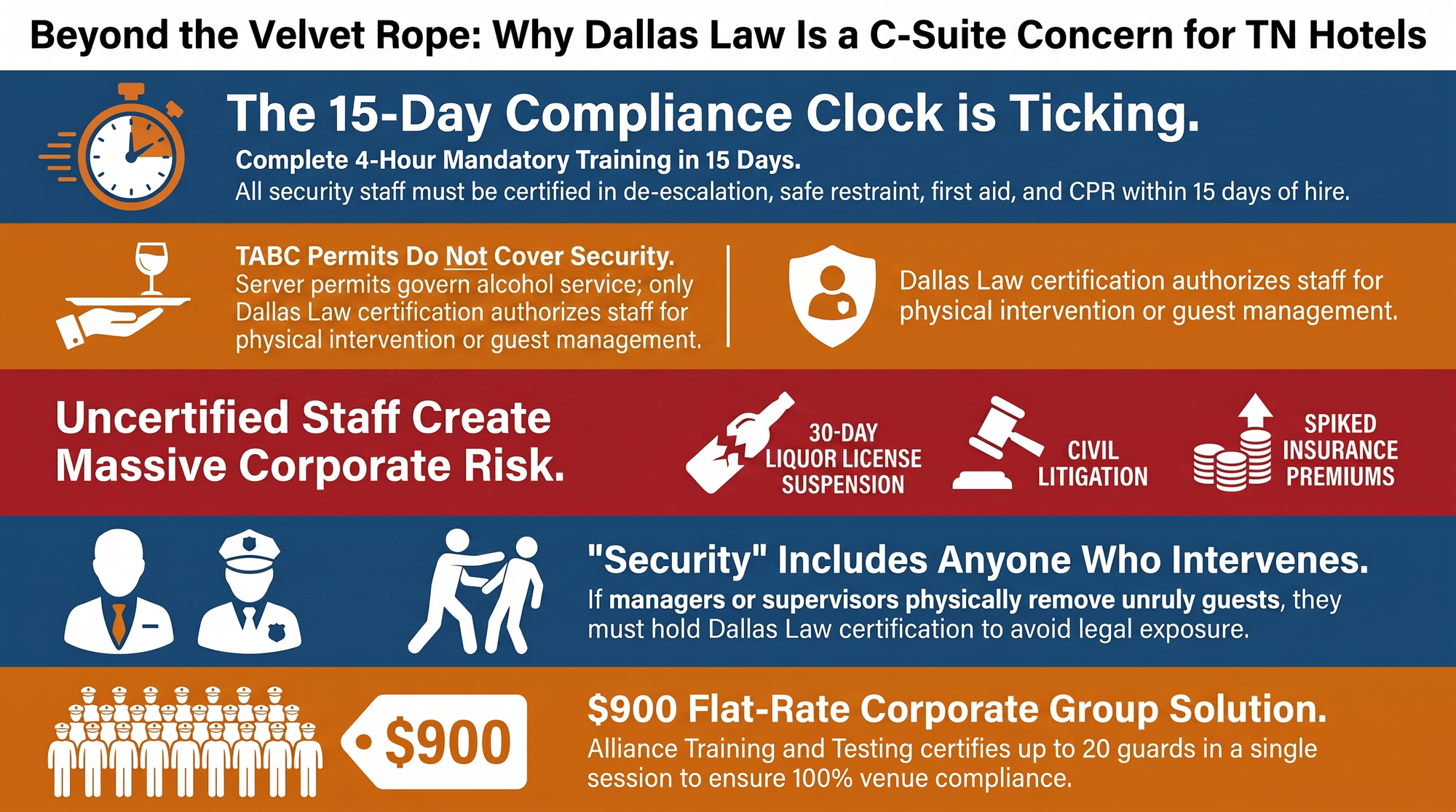
- The 15-Day Clock: In-house hotel security staff and door personnel must complete 4 hours of mandatory specialized training (de-escalation, safe restraint, first aid, CPR) within 15 days of deployment.
- TABC vs. Dallas Law: A TABC server permit only authorizes alcohol service; it does not satisfy state legal requirements for handling disruptive patrons, de-escalation, or physical intervention.
- Corporate Risk: Operating with uncertified guards exposes hotel ownership to TABC liquor license suspensions, severe civil liability, and TDCI regulatory fines.
- The Solution: Alliance Training and Testing offers a $900 flat-rate corporate group package to train and certify up to 20 venue guards in a single comprehensive session ($40/student for additional guards).
Beyond the Velvet Rope: Why Dallas Law Is a C-Suite Concern for TN Hotels
An elegant wedding reception in a ballroom, a high-energy corporate mixer on a rooftop lounge, or a quiet nightcap at the lobby bar—these are hallmarks of a premier hospitality experience. However, for hotel general managers, HR directors, and risk managers in Tennessee, they also represent significant liability risks.
When Tennessee enacted Dallas Law, public attention focused heavily on downtown nightclubs and bars. Yet the statute and official Tennessee Department of Commerce and Insurance (TDCI) rules apply directly to any establishment holding an on-premises alcohol or beer permit.
Unlike standalone bars, luxury hotels operate complex environments serving diverse clientele across multiple venues under one roof. An incident handled improperly by untrained staff doesn't just invite a personal injury lawsuit—it can tarnish a multi-million-dollar hospitality brand overnight.
Key Provisions of Dallas Law Affecting Hotel & Hospitality Venues
Understanding the specific regulatory mechanics under TDCI Chapter 0780-05-02 is essential for mitigating operational risk.
1. The 15-Day Mandatory Training Window
Under TDCI Rule 0780-05-02-.24(1), any security guard employed by a hotel operating a Proprietary Security Organization (PSO) or contracted security firm at an alcohol-permitted venue must complete specific training within 15 days of beginning work:
- De-Escalation Techniques (Minimum 1 Hour)
- Proper and Safe Restraint Techniques (Minimum 1 Hour)
- First Aid Training (Minimum 1 Hour)
- Cardiopulmonary Resuscitation (CPR) (Minimum 1 Hour)
2. Who Is Classified as Performing Security Duties?
Under state rules, anyone whose primary duty includes physical intervention, access control, or managing disruptive guests must hold a valid security registration with active Dallas Law classifications attached.
If front desk managers, F&B supervisors, or event coordinators step in to physically restrain or remove an unruly patron without proper state certification, the hotel faces direct legal exposure.
3. TABC Server Permits Are Not Enough
A common misconception among hotel managers is that a TABC card covers all alcohol-related compliance. A TABC permit regulates the service of alcohol; it offers zero legal protection or authorization when staff must manage an intoxicated individual.
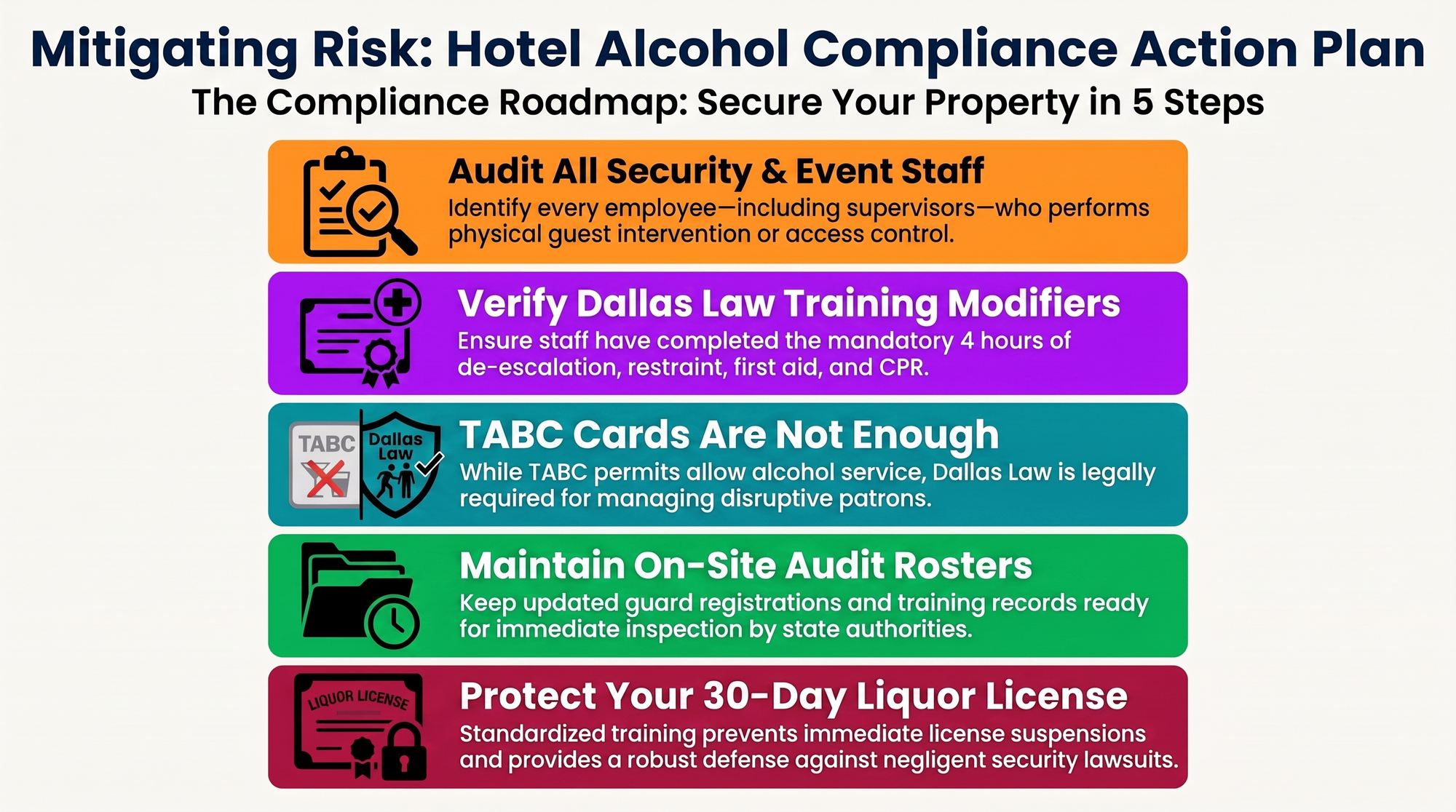
Mitigating Risk: Action Plan for Hotel Alcohol Compliance
To insulate your property from regulatory action and costly litigation, execute this proactive risk-management roadmap:
┌────────────────────────────────────────┐
│ 1. Audit Security & Event Staff Roster │
└───────────────────┬────────────────────┘
│
▼
┌────────────────────────────────────────┐
│ 2. Verify Dallas Law Modifiers on File │
└───────────────────┬────────────────────┘
│
▼
┌────────────────────────────────────────┐
│ 3. Schedule Group Certification Training│
└───────────────────┬────────────────────┘
│
▼
┌────────────────────────────────────────┐
│ 4. Maintain On-Site Rosters for Audits │
└────────────────────────────────────────┘
Step 1: Audit Security & Event Staff Rosters
Review all personnel working in security, door management, or physical guest-intervention roles across your lobby bars, rooftop venues, and convention spaces.
Step 2: Verify Dallas Law Modifiers
Ensure every guard on duty has submitted the proper state applications and holds active TDCI classifications for de-escalation, restraint, first aid, and CPR.
Step 3: Vet Third-Party Event Security
When hiring external security contractors for large galas or private events, demand proof of active Tennessee guard registrations and complete Dallas Law training records. Under TDCI Rule 0780-05-02-.18(4), venues must maintain updated guard rosters on-site for immediate inspection by state authorities.
Step 4: Standardize Group Training with Alliance Training and Testing
Managing staggered individual training deadlines for a rotating hospitality staff creates administrative headaches.
Alliance Training and Testing solves this with a $900 Flat-Rate Corporate Group Package. We deliver comprehensive, state-approved training for up to 20 venue guards in a single structured session ($40/student thereafter), ensuring your property maintains 100% Dallas Law compliance without disrupting daily operations.
The ROI of Compliance: Protecting Your Brand & Bottom Line
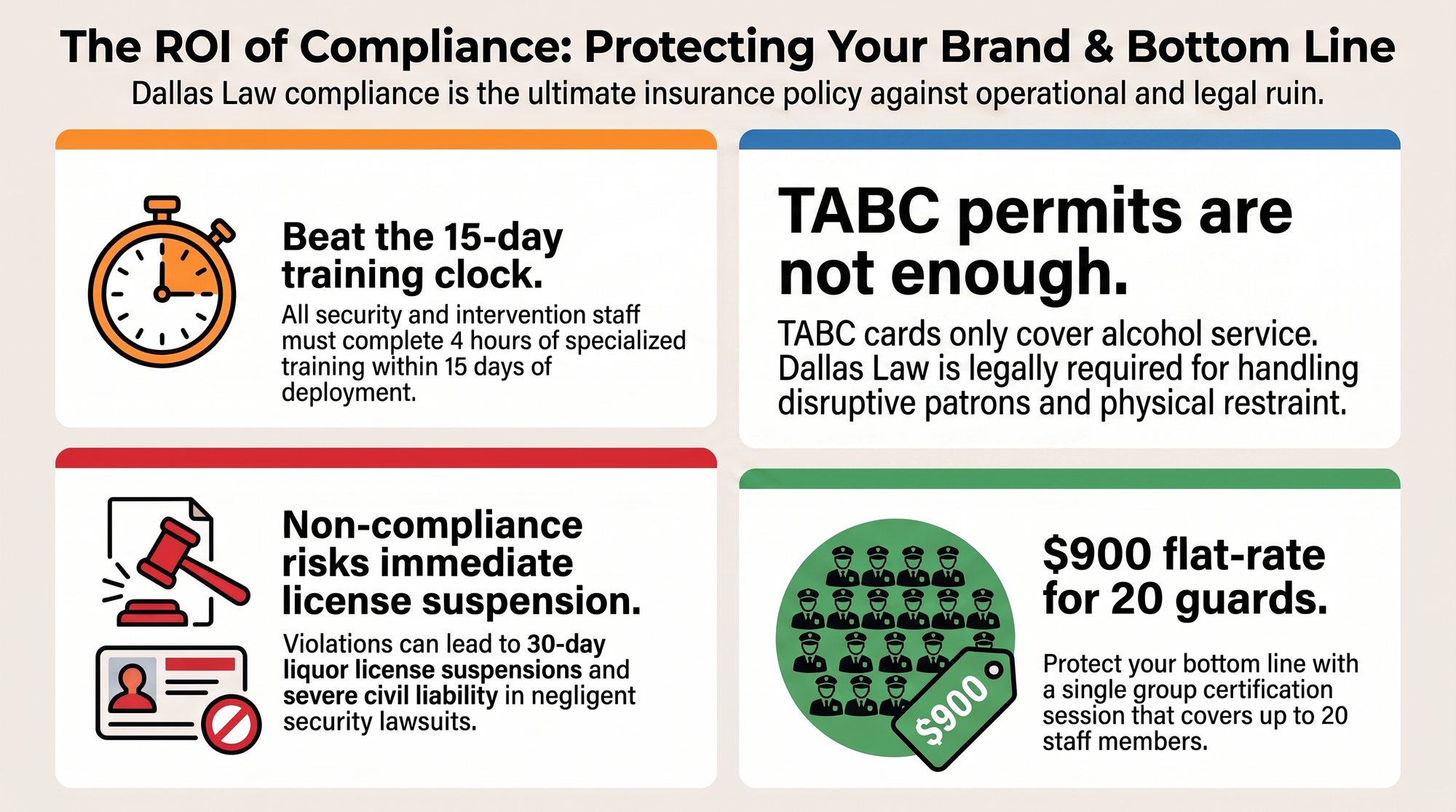
Viewing Dallas Law compliance as a mere administrative cost is a strategic mistake. It is an essential investment in corporate risk management:
- Prevent License Suspensions: Non-compliance can lead to immediate 30-day liquor license suspensions for the property.
- Reduce Litigation Exposure: In negligent security lawsuits, proving that your staff completed state-mandated de-escalation and safe-restraint training provides a robust legal defense.
- Protect Insurance Premiums: Demonstrating standardized compliance helps prevent insurance policy spikes or coverage cancellations following an on-property incident.
Frequently Asked Questions (FAQ)
1. Does Dallas Law apply to boutique hotels with small lobby bars?
Yes. The law applies to any commercial establishment holding an on-premises consumption permit from the TABC or a local beer board, regardless of square footage or hotel class.
2. Can hotel managers perform security duties without Dallas Law certification?
If a manager's duties regularly involve physically confronting or restraining intoxicated guests, they must complete the required state security registration and Dallas Law training modules.
3. How quickly must new hotel security hires complete Dallas Law training?
New security personnel must submit their state application prior to deployment and complete all mandatory de-escalation, restraint, first aid, and CPR modules within 15 days of starting work.
4. How does the $900 corporate package work for hotel staff?
Alliance Training and Testing provides group instruction for up to 20 employees for a flat fee of $900 ($40 per additional student), covering all four required Dallas Law modules in an efficient, professional setting.


