

A security professional's duty notebook is a legally discoverable document used to record contemporaneous, objective facts during an incident. It serves as the raw data matrix for the official incident report and provides critical legal protection for the officer. While incident reports are drafted after the fact, field notes capture unblemished details before human memory degrades.
The Tactical Duty Notebook: Mastering Objective Fact Collection | @guardtrainingtn
Notebook Hardware and Setup Requirements
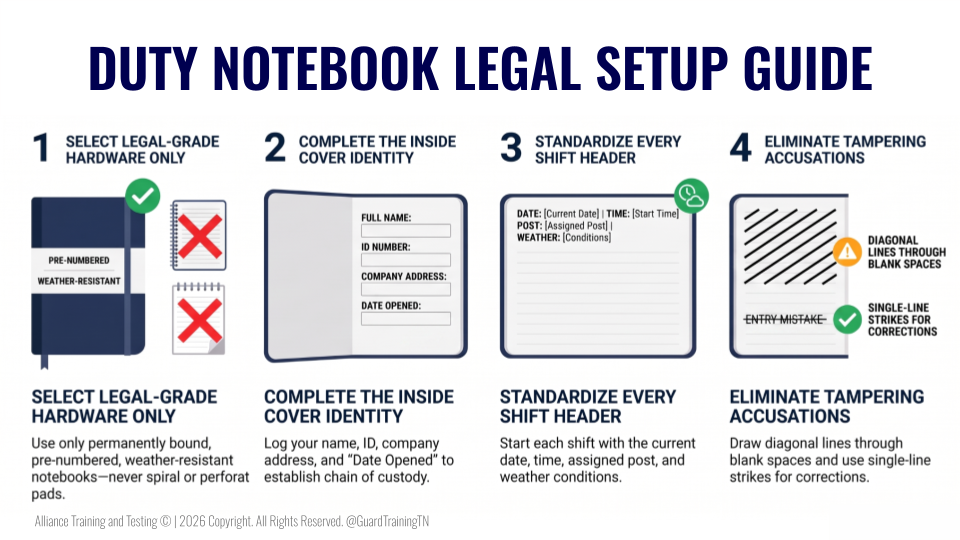
To withstand legal scrutiny and environmental hazards, a duty notebook must meet specific physical criteria:
- Bound Pages Only: Never use spiral-bound or perforated pads. Pages must be permanently stitched to prevent tampering accusations.
- Pre-Numbered Pages: Sequential numbering proves no pages were removed or skipped to alter timelines.
- Weather-Resistant: Use sturdy covers and water-resistant paper to survive field conditions.
Initial Setup
Officially "Open" a fresh notebook before logging the first patrol.
- The Inside Cover: Write your full name, employee ID, company name, company address (critical for return if lost), and the start date. Leave a blank line for "Date Completed."
- Shift Headers: Begin every shift on a new line with the current date, start time, assigned post, and weather conditions.
Legal Retention and Chain of Custody
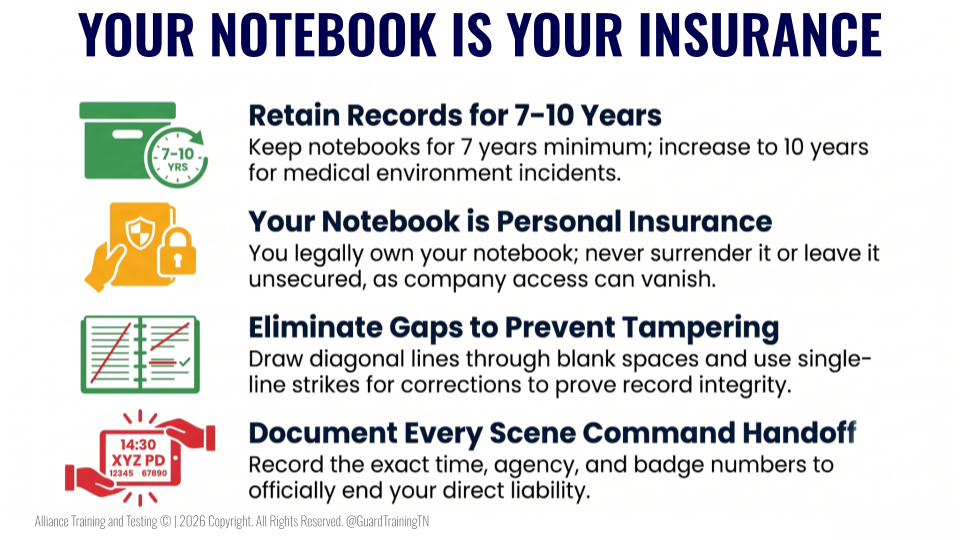
Change your notebook at least annually, or when it is completely full. When retiring a book, draw a diagonal line through any remaining blank space on the final page and log the "Date Completed" on the front cover.
Data Retention Policies
- Standard Retention: Retain old notebooks for at least 7 years to satisfy the Tennessee statute of limitations.
- Medical Environments: Increase retention to 10 years if an incident involved a patient.
The Chain of Custody Reality Check
The security officer legally owns the duty notebook, while the employer owns the official incident report. In a legal dispute with an employer, your access to company files and past reports will disappear overnight. Your personal duty notebook may be the only contemporaneous evidence available without forcing a lawyer to subpoena it. Treat it as your personal insurance policy—never throw it away, and never leave it unsecured.
Objective Fact-Gathering: The "Camera Lens" Rule
The most common trap security professionals fall into is recording their interpretation of an event rather than the verifiable facts. A duty notebook must be an entirely neutral, unbiased record. Apply the Camera Lens Rule: If a security camera cannot physically record it, it does not belong in the notes. Cameras cannot record emotions, motives, or assumptions; they only capture observable, physical data.
- Filter Out Emotion: Record physical actions ("shouting loudly and waving a clenched fist"), not interpretations ("furious").
- Filter Out Assumptions: Record physical evidence ("empty glass bottle of whiskey," "sweating heavily"), not diagnoses ("drunk," "nervous").
- Filter Out Guesses: Never speculate on a subject's motives unless they explicitly state them to you.
Discoverability and Rules of Entry
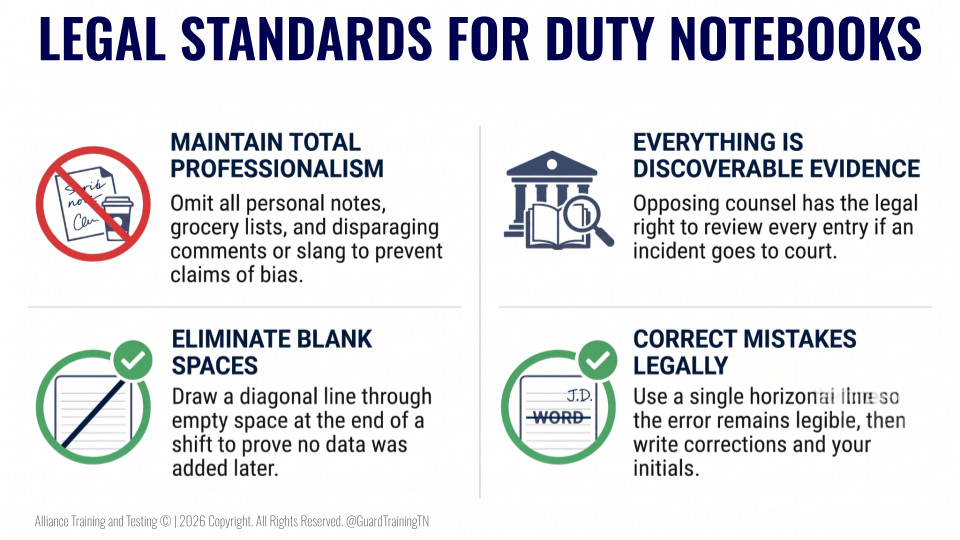
Everything written in your notebook—and every device you use to collect evidence—is "Discoverable Evidence." If an incident goes to court, opposing counsel has the legal right to review it. Keep these strict boundaries in mind:
- No Personal Notes: Grocery lists or personal errands demonstrate a lack of professionalism and focus to a jury.
- Zero Disparaging Comments: Omit opinions, slang, or derogatory terms, which give defense attorneys the ammunition to paint the officer as biased or aggressive. Stick to factual physical descriptions.
- No Blank Spaces: Draw a single diagonal line through any empty space at the end of a shift to prove no information was added later.
How to Make Corrections Properly
Never use correction fluid (White-Out) or completely scribble out errors. Obscuring an error looks like hiding evidence. Draw a single horizontal line through the mistake so it remains legible, write the correction immediately next to or above it, and place your initials next to the correction.
Leveraging Digital Technology Legally
Smartphones and body cameras are incredible tools for evidence collection, but they carry massive legal risks if used improperly.
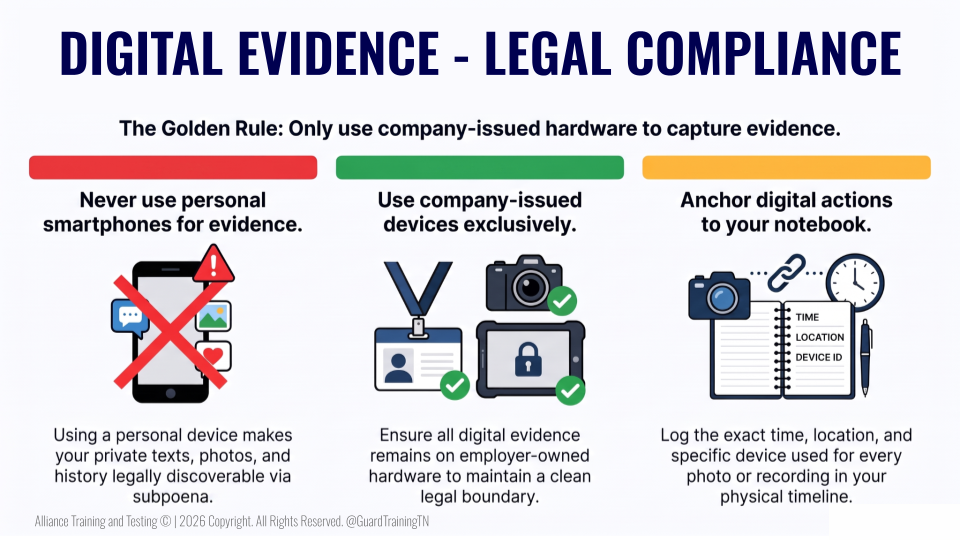
- Use Company Devices Only: Using a personal smartphone for evidence collection makes the entire personal device (including private texts, photos, and browsing history) legally discoverable via subpoena. Only use company-issued devices.
- Anchor Digital to Physical: Document digital evidence creation in the notebook timeline (e.g., "At 0215 hrs, observed forced entry at the rear loading dock. Took 3 photos of the broken padlock using the company-issued device").
On-Scene Execution and Interview Protocols
When an incident is active, your notebook acts as a raw data matrix detailing precise chronology, environmental baselines (lighting, specific coordinates), and action mechanics (how an individual bypassed security).
Prioritize safety and first aid, secure the scene, and immediately isolate sources to prevent memory cross-contamination.
Gathering Witness and Victim Testimony
- Ask open-ended questions (e.g., "Can you describe what you saw?").
- Provide a supportive, calm environment to help them recall details accurately.
- Record statements using direct quotes wherever possible for maximum accuracy.
Handling Offender Statements
Security officers are not law enforcement; you do not conduct interrogations.
- Do not press a suspect for a confession or ask leading questions to establish guilt.
- Observe and record spontaneous utterances. If a detained suspect randomly yells, "I only punched him because he looked at me funny!", write exactly that down in quotation marks, noting the exact time it was said.
The Handoff: Transferring Scene Command
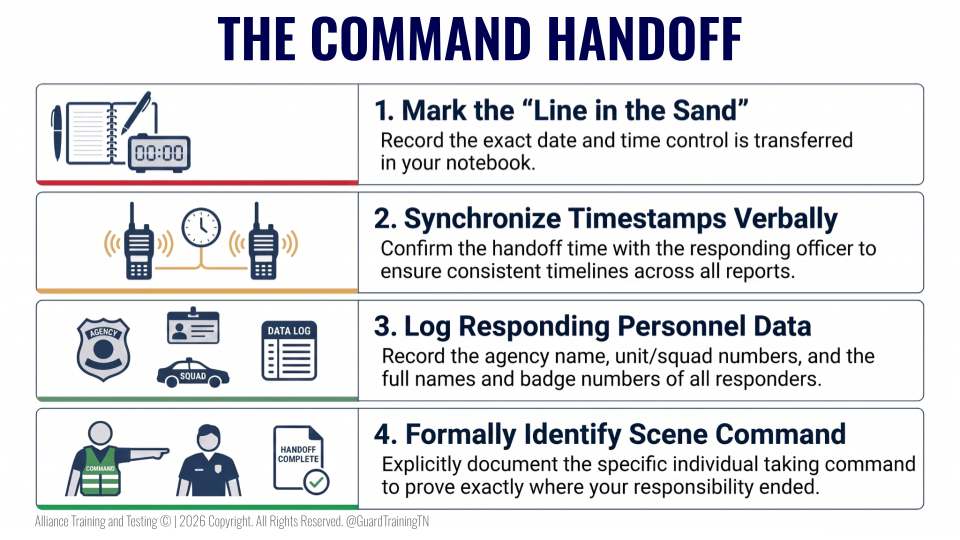
When external emergency services (law enforcement, fire, EMS) arrive, a critical transition occurs. You are no longer the primary authority, and you must explicitly document this transfer of power.
- Draw a Line in the Sand: Record the exact date and time you transferred control. Verbally confirm this timestamp with responding officers (e.g., "Officer, I have the time of handoff at exactly 2143 hours, do you agree?") to synchronize timelines across official reports.
- Identify Personnel: Log the agency name, unit/squad numbers, and the names and badge numbers of responding personnel.
- Identify Scene Command: Document exactly who is taking command (e.g., "Scene command transferred to Sgt. Miller, Metro PD, Badge #4492 at 2143 hrs"). This officially documents where your direct liability for managing the incident ends.
Conclusion
Ultimately, a tactical duty notebook is much more than a simple pad of paper—it is a security professional's most reliable insurance policy and a cornerstone of legal defense. By adhering to strict physical standards, eliminating personal bias through the "Camera Lens Rule," and meticulously tracking the chain of custody, you protect both your integrity and your career. In the chaotic aftermath of a critical incident, human memory will inevitably fade, and official company files may become inaccessible. A properly maintained duty notebook ensures your account of the facts remains unshakeable. Treat your notebook with the professionalism your job demands, and it will serve as your strongest advocate when the pressure is on.
Frequently Asked Questions (FAQ)
What is a security duty notebook? A security duty notebook is a legally discoverable, bound document that security professionals use to record objective, contemporaneous facts during a shift or incident. It serves as the primary, unblemished data source for writing official incident reports and protects the officer during legal scrutiny.
How long should security professionals keep their duty notebooks? Security professionals should retain their duty notebooks for at least 7 years to comply with standard statutes of limitations. If the notebook contains details regarding a medical incident involving a patient, retention should be increased to at least 10 years.
Can I use a spiral notebook for security field notes? No, you should never use a spiral-bound or perforated notebook for security field notes. Duty notebooks must have permanently stitched, bound, and pre-numbered pages. This proves to a court that no pages were removed, skipped, or altered to manipulate a timeline.
How do you legally correct a mistake in a duty notebook? To correct a mistake, draw a single horizontal line through the error so the original text remains completely legible. Write the correct information directly next to or above it, and place your initials next to the correction. Never use White-Out or scribble out the mistake, as opposing counsel can argue you are hiding evidence.
Can I use my personal cell phone to take pictures of a security incident? No, you should only use company-issued devices to collect digital evidence. If you use a personal smartphone to take photos of a security incident, your entire device—including private text messages, personal photos, and browsing history—becomes legally "discoverable" and can be subpoenaed in court.
What is the "Camera Lens Rule" in security note-taking? The Camera Lens Rule states that security officers should write down only what a camera could physically record. Notes must be entirely neutral and free of emotion, assumptions, or guesses. For example, instead of writing that a subject was "furious and drunk" (an assumption), you would write that the subject was "shouting loudly, waving a clenched fist, and holding an empty glass bottle of whiskey" (observable facts).
,
Security Guard Training - The Legal Guide to Duty Notebooks @guardtrainingtn