
Tactical Command Presence @guardtrainingtn | Mastering Security Guard Authority
Quick Answer: Security guard command presence is the non-verbal projection of authority and competence, primarily established through a pristine uniform, meticulous personal grooming, and confident body language. It is a vital tactical tool for deterring threats, de-escalating conflicts, and building public trust before a single word is spoken.
Before you speak a single word, your uniform speaks for you. Within seconds of entering a space, people make a subconscious judgment about your authority, competence, and readiness. That initial assessment often determines whether a trespasser backs down or pushes their luck, and whether the public feels secure or anxious.
This is the essence of command presence—a powerful, non-verbal projection of authority. It is not about intimidation; it is about establishing immediate, unquestionable competence. This guide breaks down the critical role your uniform and grooming play in cultivating that presence, earning respect, and performing your duties safely.
The ROI of Command Presence in Security
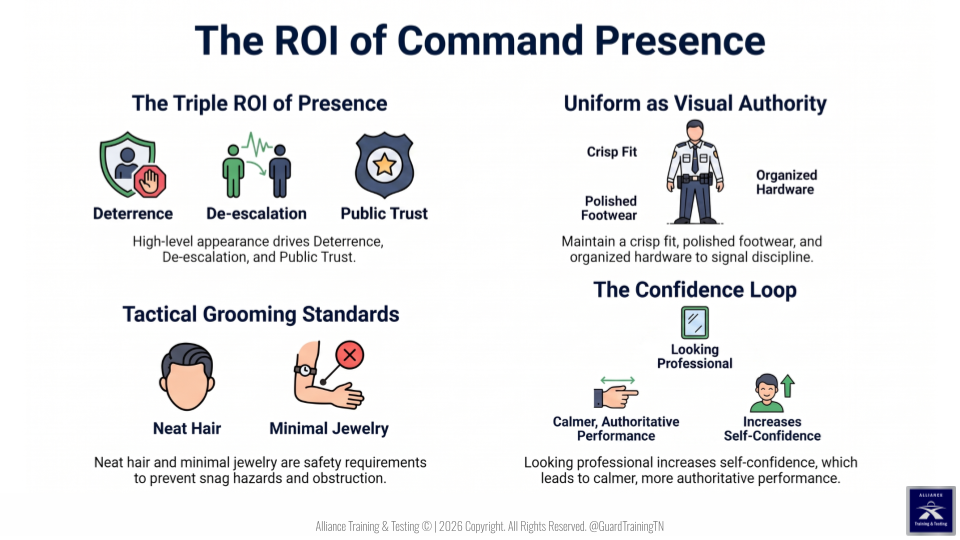
Command presence is the natural air of authority you project through confidence, posture, and appearance. For a security professional, it is a primary tactical tool that delivers immediate returns:
- Deterrence: Bad actors look for soft targets. A sharp, alert, and squared-away officer signals that a location is actively protected and not worth the risk.
- De-escalation: A calm, controlled, and visually professional demeanor defuses tension. People naturally defer to those who look in charge.
- Public Trust: A well-put-together guard reassures clients, employees, and the public, building trust in the security infrastructure.
The Security Uniform: Your Visual Authority
Your uniform is your brand, your shield, and your most visible credential. A crisp, properly fitted uniform communicates discipline and attention to detail. A sloppy one communicates apathy—and apathy invites challenges.
Essential Uniform Standards for Security Professionals
To ensure your uniform actively supports your command presence, adhere to these non-negotiable baselines:
- The Fit: A uniform that is too baggy looks sloppy and allows bad actors an easy handhold in a scuffle. One that is too tight restricts movement and draws the wrong kind of attention. Gear must be tailored for an active, professional fit.
- The Finish: Shirts and trousers must be free of stains, wrinkles, and odors. Inspect your uniform before every single shift.
- The Footwear: Boots and shoes take a beating, but they must be clean, scuff-free, and polished. Worn-out, dusty footwear is an immediate tell for a lack of discipline.
- The Hardware: Badges, patches, and nameplates must sit straight, secure, and untarnished, placed exactly according to company Standard Operating Procedures (SOP).
- The Duty Belt: Keep gear organized, clean, and functional. Avoid unnecessary clutter. Muscle memory relies on your gear being in the exact same place every time.
Beyond the Fabric: Professional Grooming Standards
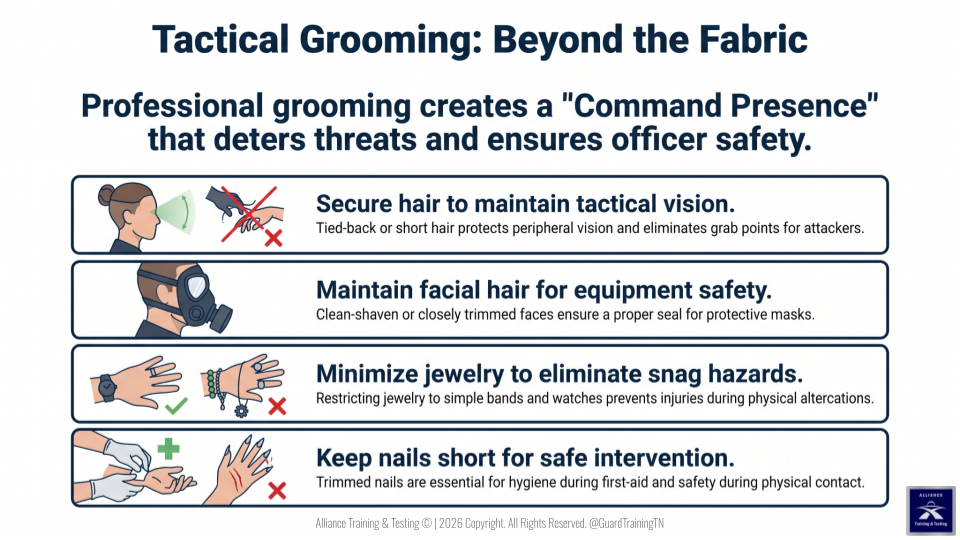
A flawless uniform is easily undermined by poor grooming. Personal hygiene and grooming demonstrate self-respect and discipline—the building blocks of projecting authority.
While specific policies vary by employer, these baseline standards apply to nearly all elite security roles:
The Confidence Loop: How Appearance Drives Performance
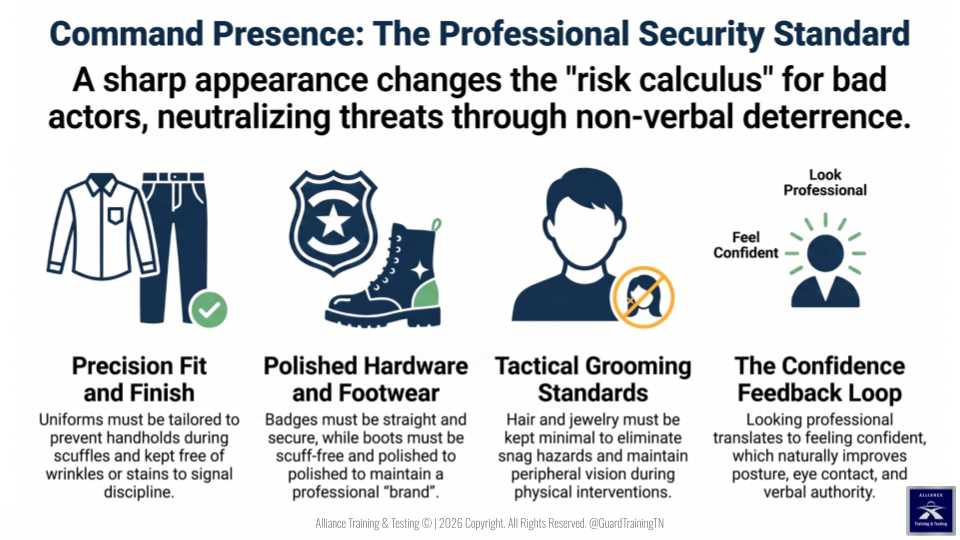
Studies consistently show that most human communication is non-verbal. When you look the part of a professional, you establish a baseline of respect before you ever have to issue a verbal command.
This creates a powerful psychological feedback loop. When you know your uniform is sharp and your boots are shined, your posture naturally improves. You stand taller. You maintain steadier eye contact. You speak with a calmer, clearer cadence. Looking good translates directly into feeling confident, and feeling confident is exactly what allows you to act with authority when it matters most.
Mastering these details means you aren't just wearing clothes to a job. You are deliberately constructing an aura of control that deters threats and ensures safety. Ready to combine this visual authority with tactical skills? Explore advanced security training courses to master verbal de-escalation, tactical communication, and situational awareness to complete your professional toolkit.
Frequently Asked Questions
What is the single most important aspect of a security guard's appearance? Consistency is the most important aspect of a security guard's appearance. Maintain a clean, well-fitting uniform, professional grooming, and confident posture on every shift. A single weak link—like an untucked shirt or scuffed boots—immediately degrades your command presence.
Can a security guard have a beard or visible tattoos? Yes, but it depends on the specific security company and the client site. Many modern companies allow neatly trimmed beards and non-offensive arm tattoos. However, tattoos on the face, neck, or hands are still widely prohibited across the industry. Always defer to your employer's specific SOP.
How does command presence actually prevent fights? Command presence prevents fights by changing the aggressor's risk calculus. If a guard issues a firm verbal instruction while projecting complete control and readiness, an unruly individual is far more likely to comply. The guard's appearance establishes that they are not an easy target, often neutralizing the threat without physical intervention.
Is command presence natural or learned? Command presence is absolutely a learned skill. While some individuals naturally carry themselves well, true command presence is built through daily discipline: maintaining your appearance, practicing open and confident body language, and reinforcing it with professional tactical training.
Your Uniform is a Tactical Shield | Security Guard Command Presence @guardtrainingtn