
Quick Answer (TL;DR): In Tennessee, private security guards have no law enforcement authority to conduct non-consensual searches of persons, bags, or vehicles. Regulated under the Private Protective Services Licensing and Regulatory Act (T.C.A. § 62-35-101 et seq.) and affirmed by Tennessee Attorney General Opinion No. 03-022, security officers have the legal authority of private citizens and property-owner agents—even when contracted at government facilities. All searches require effective consent (T.C.A. § 39-11-106(a)(9)), except for limited investigative detentions under Tennessee's Merchant's Privilege statute (T.C.A. § 40-7-116).
Tennessee Security Guard Search & Seizure Laws (2026 Guide) @guardtrainingtn
Imagine you are on duty as a registered security officer at a crowded venue on Lower Broadway in Nashville or patrolling a distribution hub in Memphis. You spot an individual acting suspiciously with a bulky backpack. Your training instinct is to intervene, but one question dictates your next move: What am I legally allowed to do under Tennessee law?
For security professionals, misunderstanding the line between property protection and unlawful search or seizure doesn't just cost you a job—it exposes you to felony charges, automatic revocation of your state registration card, and devastating civil lawsuits. This comprehensive guide breaks down the federal laws, Tennessee statutes, and Tennessee Attorney General Opinions that govern how security guards handle bags, vehicles, pat-downs, and detentions.
Federal vs. State Law: Does the Fourth Amendment Apply to Tennessee Security Guards?
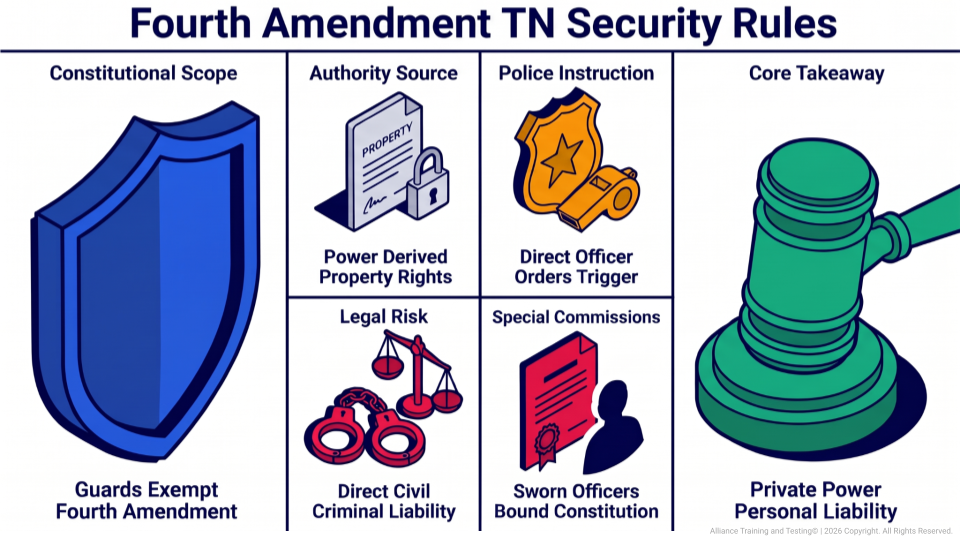
No, the Fourth Amendment of the U.S. Constitution (and Article I, Section 7 of the Tennessee Constitution) generally does not apply to private security guards. Under U.S. Supreme Court precedent in Burdeau v. McDowell (256 U.S. 465), constitutional search-and-seizure protections restrict only government actors, such as sworn police officers, not private security personnel acting independently.
However, security guards must never confuse "exempt from the Fourth Amendment" with "permission to search." While a police officer derives authority from the state, a Tennessee security guard derives authority strictly from private property rights and contractual employment (T.C.A. § 62-35-102(18)).
The "State Actor" Exception & The Exclusionary Rule Myth
Many guards mistakenly believe that the worst consequence of an illegal search is that stolen property or contraband will be thrown out of court under the "fruit of the poisonous tree" doctrine.
In reality, because private security guards are not government agents, evidence a guard seizes unlawfully on their own is often still admissible in criminal court. Instead of punishing the prosecutor by suppressing evidence, the justice system punishes you and your employer directly through criminal prosecution (assault, false imprisonment, theft) and civil tort liability.
When does the Fourth Amendment apply to a security guard? Your actions cross into "state action"—triggering full Fourth Amendment restrictions—if:
- Direct Police Instruction: A sworn law enforcement officer directs, requests, or encourages you to open a bag, pat someone down, or search a car.
- Off-Duty Sworn Peace Officers: You are a full-time sworn peace officer working secondary private security employment. Off-duty officers may wear their official agency uniform with departmental approval while working private contracts, but they remain bound by constitutional law enforcement standards when exercising police powers (T.C.A. § 62-35-141; TN AG Opinion Nos. 00-166, 16-43, and 17-28).
- Commissioned Special Police vs. Private Campus Guards: You hold a special police commission appointed by a municipal chief of police or county sheriff at a private college or university, which requires POST-equivalent law enforcement qualifications (T.C.A. § 62-35-103(a)(14)). By contrast, uncommissioned security guards employed directly by a private college operate under a Proprietary Security Organization and possess only private citizen authority (T.C.A. § 62-35-123; TN AG Opinion No. 06-146).
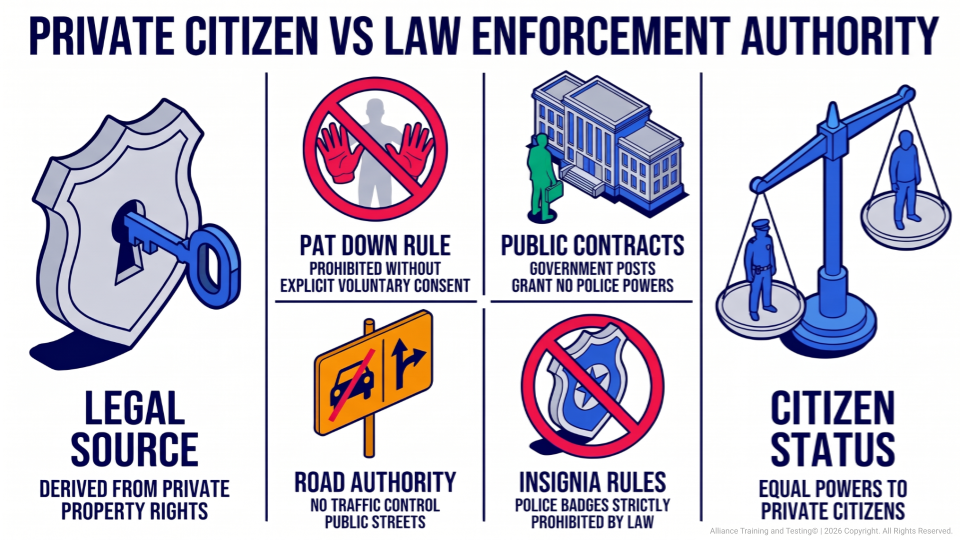
Private Citizen vs. Law Enforcement Authority Under T.C.A. Title 62, Chapter 35
Under Tennessee law, a registered armed, unarmed, or enhanced armed security guard holds the exact same search and arrest powers as an ordinary private citizen. Your primary statutory mandate is to protect persons or property by observing, deterring, enforcing private property rules, and reporting unlawful activity (T.C.A. § 62-35-102(18)).
To pass Tennessee's mandatory Legal Powers and Limitations training module, every guard must understand how their authority differs from sworn law enforcement (T.C.A. § 62-35-118(a)(2)(A)(ii); TN Rule 0780-05-02-.07(2)(b)):
Key Insights from Tennessee Attorney General Opinions on Security Guard Authority
The Tennessee Attorney General's Office has issued several landmark formal opinions interpreting the Private Protective Services Licensing and Regulatory Act. Every security professional and trainer in Tennessee should know these four binding principles:
- Contracting at a Government Building Does Not Give You Police Powers (TN AG Opinion No. 03-022): What if your contract security company assigns you to guard a city hall, county courthouse, or state/federal facility—and requires you to screen bags at the door? In Opinion No. 03-022, the Tennessee Attorney General ruled that private security guards employed by a contract security company are not exempt from T.C.A. Title 62, Chapter 35 when fulfilling a government contract, and that working at a government post does not convert a private guard into a police officer. Your authority at a government checkpoint remains strictly administrative and consent-based.
- No Authority to Stop Vehicles or Direct Traffic on Public Streets (TN AG Opinion No. 03-022 & Opinion No. 05-011): Security guards are authorized to control, regulate, or direct the flow of the public—whether by vehicle or on foot—strictly on private property (T.C.A. § 62-35-102(18)(D)). In Opinion No. 03-022 (and partially reconsidered in Opinion No. 05-011), the Attorney General emphasized that private security guards are not police officers and have no statutory authority to enforce traffic laws, stop vehicles, or direct traffic on public streets or thoroughfares—a power reserved for sworn officers, including certified officers in temporary work zones (T.C.A. § 62-35-103(a)(15)).
- Authority is Tied Strictly to Preventing Criminal Activity on Private Property (TN AG Opinion No. 02-123): In Opinion No. 02-123, the Attorney General confirmed that statutory security guard services are defined specifically by the "protection of persons or property, or both, from criminal activities" (T.C.A. § 62-35-102(18)). Because activities like escorting funeral processions on public roads do not involve protecting private property from criminal acts, they fall outside the Act's jurisdiction.
- Private Campus Security vs. Sworn Officers (TN AG Opinion No. 06-146): In Opinion No. 06-146, the Attorney General confirmed that when a private university employs its own unarmed or armed security guards, the institution is regulated as a Proprietary Security Organization (PSO) (T.C.A. § 62-35-123), and its guards must hold state registration cards (T.C.A. § 62-35-115). Unless a campus officer holds a special police commission (T.C.A. § 62-35-103(a)(14)), they cannot search a student's dorm room, backpack, or vehicle without effective consent or contractual housing inspection authority.
Strict Prohibition on Police Impersonation (T.C.A. § 62-35-127 & § 62-35-134)
Never attempt to intimidate someone into a search by acting like a police officer. Under Tennessee law, it is strictly unlawful for a security guard to:
- Display Police Markings: Wear any badge, patch, or insignia containing the word "police" or resembling a Tennessee law enforcement agency (T.C.A. § 62-35-127).
- Wear Unmarked Police-Style Uniforms: Wear a military- or police-style uniform without a distinct patch over the left breast pocket that clearly identifies you as private security (T.C.A. § 62-35-128).
- Use Innuendo or Insinuation: You cannot use any statement, innuendo, or insinuation that would cause a reasonable person to believe you are a sworn peace officer or government official (T.C.A. § 62-35-134(c)(5)).
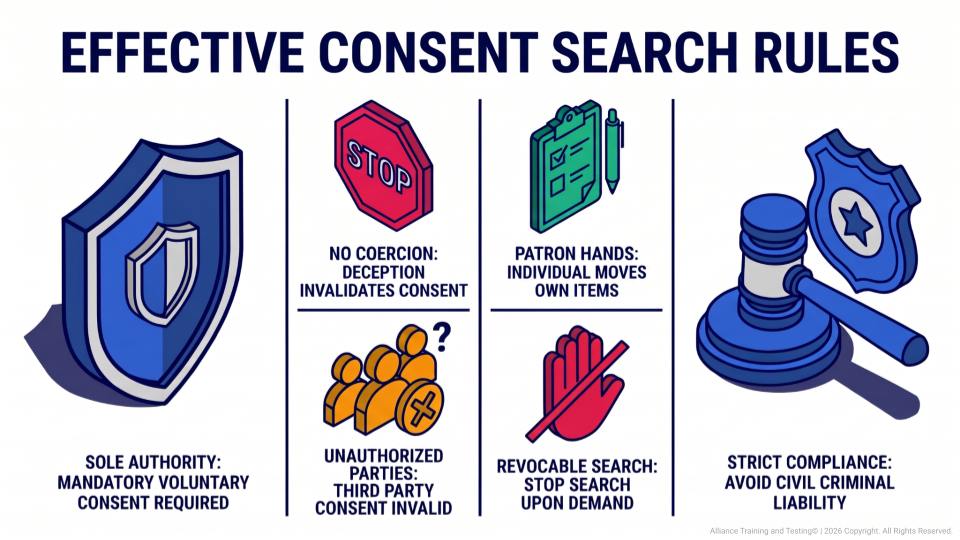
The Golden Rule of Private Security Searches: "Effective Consent" in Tennessee
Because private security guards cannot obtain search warrants (which magistrates and law enforcement alone may obtain under T.C.A. § 40-6-101), the only lawful way to search a person, bag, or vehicle is through effective consent.
In Tennessee, consent is not simply getting someone to nod their head under pressure. State law defines "Effective Consent" and explicitly states that consent is legally invalid if it is: (T.C.A. § 39-11-106(a)(9)):
- Induced by Deception or Coercion: "Coercion" includes threatening to commit an offense, wrongfully accusing someone of an offense, exposing them to public ridicule, or claiming you will take action as a public servant (T.C.A. § 39-11-106(a)(4) & (a)(9)(A)). Saying, "Let me search your purse right now, or I'm locking you in the back room," invalidates consent.
- Given by an Unauthorized Person: One patron cannot give you permission to search another patron's backpack (T.C.A. § 39-11-106(a)(9)(B)).
- Given by Someone Unable to Make Reasonable Decisions: If a person is severely intoxicated (a frequent scenario for guards working at alcohol-licensed venues under T.C.A. § 62-35-118(a)(2)(B)), a minor, or suffering from a mental defect, they cannot legally grant effective consent to a complex search (T.C.A. § 39-11-106(a)(9)(C)).
Best Practice for Guards: Always keep consent voluntary, clear, and revocable. Having the patron move their own items keeps your hands out of their property and prevents accusations of theft or planting items. If they say "stop" at any point, stop immediately.
Legal Limitations on Searching Bags, Vehicles, and Persons
Every search scenario carries distinct legal boundaries under Tennessee law.
1. Searching a Person (Pat-Downs, Wands, and Frisks)
A private security guard in Tennessee has no legal authority to forcibly touch, frisk, or pat down an individual without their explicit consent.
- No "Terry Frisk" Authority: The famous Terry stop-and-frisk is a constitutional tool reserved exclusively for sworn law enforcement officers with reasonable suspicion that a suspect is armed.
- Hands-Off Rule: Touching a person's body or pockets without permission can result in criminal charges for Assault or civil lawsuits for Battery.
- Use Magnetometers and Handheld Wands: At event checkpoints, bars, or schools, use walk-through metal detectors or handheld security wands rather than physical pat-downs. If a wand alerts on a pocket, ask the individual to empty their own pockets into a tray.
- Strip Searches Are Strictly Restricted: Strip searches are heavily restricted even for police officers and must never be performed by private security under any circumstances (T.C.A. § 40-7-119).
2. Searching Bags, Purses, and Backpacks
Bag searches are lawful in Tennessee only when conducted with voluntary consent as a condition of entry onto private property or employment premises.
- Implied vs. Express Consent at Checkpoints: Security guards may enforce rules and control the flow of the public on private property (T.C.A. § 62-35-102(18)). Venues, stadiums, and corporate facilities post clear entrance signage for bag checks ("All bags and purses are subject to inspection prior to entry").
- The Right to Refuse and Turn Away: Even with posted signs, a patron retains the absolute right to refuse a bag search. If they refuse, you cannot grab the bag or force it open. Your sole legal remedy is to politely deny them entry to the property (or ask them to leave, after which remaining on site becomes Criminal Trespass).
- Employee Locker and Bag Checks: In corporate or warehouse settings, employee bag checks must be governed by signed employment agreements and company policy. If an employee refuses a post-shift bag check at a distribution center, do not physically wrestle the bag away—document the refusal, observe clearly, and let management handle the administrative termination or call law enforcement if theft probable cause exists.
The "Seizure Trap": Can a Security Guard Confiscate Contraband or Weapons?
One of the most common mistakes guards make at checkpoints is assuming that consent to look inside a bag equals legal authority to confiscate ("seize") items inside it. Here is how to handle prohibited items legally:
- Prohibited Venue Items (Alcohol, Outside Food, Legal Pocketknives): You cannot forcibly take and keep a patron's personal property. Give the patron a clear choice: return the item to their vehicle, voluntarily dispose of it in an amnesty bin, or leave the premises.
- Firearms at "No-Gun" Private Venues: If a patron has a firearm in their bag or on their hip at a posted gun-free venue, never reach for, unholster, or take possession of their firearm. Handling a patron's loaded gun creates extreme safety and liability risks. Politely deny entry and instruct them to secure the firearm in their vehicle.
- Suspected Illegal Drugs: Never confiscate illegal narcotics into your own pockets or desk drawer. Taking possession of controlled substances—even with the intention of throwing them away or turning them over to police later—exposes you to felony drug possession charges and chain-of-custody problems. Deny entry, maintain visual observation from a safe distance, and notify law enforcement.
3. Searching Vehicles
Private security guards cannot enter or search a private vehicle—including the cabin, glove box, or trunk—without the driver's or owner's explicit, voluntary consent.
- Heightened Protection Under Tennessee Law: In Tennessee, an occupied vehicle is granted the same heightened self-defense ("Castle Doctrine") presumptions as a personal residence or dwelling (T.C.A. § 39-11-611(c)). Unlawfully forcing open a car door or reaching inside an occupied vehicle is not only illegal—it is physically dangerous and legally catastrophic.
- Private Lots Only—Never Public Roads: As affirmed by Tennessee Attorney General Opinion No. 03-022, your authority to control or inspect vehicles stops at the private property line (T.C.A. § 62-35-102(18)(D)). You cannot pull over a vehicle or conduct vehicle checks on a public street.
- The "Plain View" Observation Rule: While patrolling a private parking lot, you may legally look through vehicle windows from the outside. Looking at items sitting in plain sight on a car seat is not a "search." If you see a firearm, stolen merchandise, or contraband in plain view, do not open the door. Record the license plate, vehicle description, and location, and notify local law enforcement immediately.
- Commercial Gate Checkpoints: At industrial plants or gated truck yards where commercial vehicles enter private property, drivers may be required to open cargo trailers for visual inspection as a contractual condition of gate entry. If a driver refuses, deny gate access.
4. Never Search a Suspect's Cell Phone (T.C.A. § 40-6-110)
Modern security incidents frequently involve patrons filming guards or suspects communicating with accomplices. Under Tennessee's electronic privacy statute, even sworn law enforcement officers may not search or extract cellular telephone data without a search warrant, informed consent, or exigent circumstances (T.C.A. § 40-6-110). A private security guard has zero authority to seize a citizen's phone, demand they unlock it, or force them to delete photos or videos.
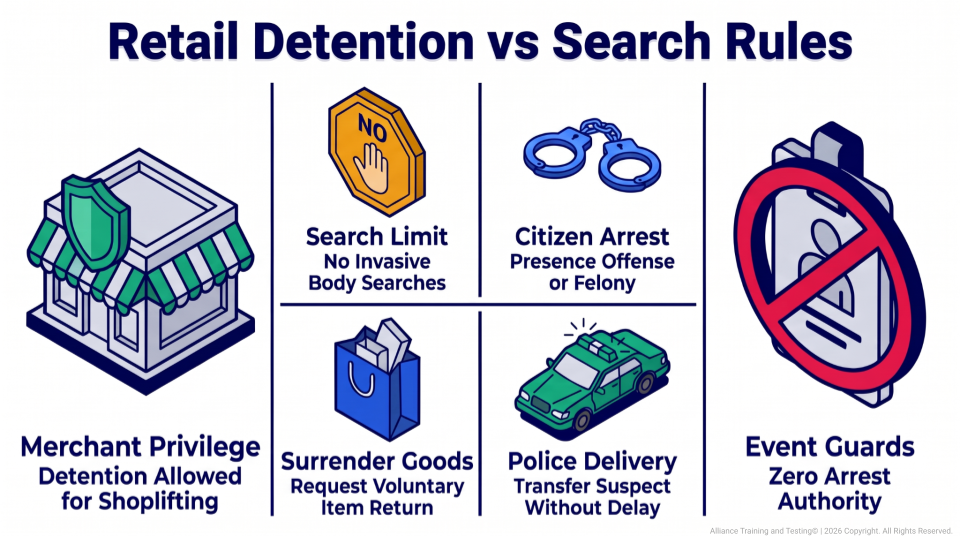
Retail Loss Prevention & Citizen's Arrest in Tennessee: Detention vs. Search
While a "search" looks for hidden property, a "seizure" occurs when you restrict a person's freedom of movement. In Tennessee, detaining someone improperly is the fastest way to face a felony False Imprisonment charge. Here are the two narrow statutory exceptions every guard must know.
1. The Merchant's Privilege / Shopkeeper's Statute (T.C.A. § 40-7-116)
Under T.C.A. § 40-7-116, a merchant, a merchant's employee, or an agent of the merchant (including contracted retail security) who has probable cause (reasonable grounds) to suspect that a person has committed or is attempting to commit theft of property may detain that person on or off the premises if the guard:
- Acts in a reasonable manner under the circumstances; and
- Detains the suspect for a reasonable period to obtain ownership of the merchandise, recover the goods, or await the arrival of a law enforcement officer.
Critical Limitation on Searching Shoplifters: While T.C.A. § 40-7-116 allows reasonable detention to recover unpurchased merchandise, it is not a blank check to conduct invasive body searches. Ask the suspect to voluntarily surrender the concealed merchandise, or wait for police officers—who have full search-incident-to-arrest powers and warrantless arrest authority (T.C.A. § 40-7-117)—to search the suspect's clothing.
(Note: Plainclothes, unarmed in-house loss prevention specialists who exclusively investigate shoplifting are exempt from guard registration under T.C.A. § 62-35-103(a)(10), whereas uniformed or contract retail security guards must be fully registered.)
2. Private Person Arrest ("Citizen's Arrest") in Tennessee (T.C.A. § 40-7-109)
Unlike states that limit misdemeanor citizen's arrests to "breaches of the peace," Tennessee's statute is specific. Under T.C.A. § 40-7-109, a private person may arrest another only when:
- A public offense is committed in the private person's presence;
- The person arrested has committed a felony, although not in the private person's presence; or
- A felony has in fact been committed, and the private person has reasonable cause to believe the person arrested committed it.
If a private citizen's arrest is executed, Tennessee law requires strict compliance with the following procedures:
- Mandatory Notice: You must inform the person of your intent to arrest them and the cause of the arrest, unless they are in the actual commission of the offense or you pursue them immediately after escape (T.C.A. § 40-7-111).
- Immediate Delivery to Police: You must deliver the arrested person to a law enforcement officer or magistrate without unnecessary delay (T.C.A. § 40-7-113). Holding someone in a security office for hours to "interrogate" them violates T.C.A. § 40-7-113 and T.C.A. § 39-11-603, which require terminating confinement as soon as safely possible unless the person is arrested and turned over.
- Temporary Event Guards Have ZERO Arrest Authority: If you are working as an unarmed temporary security officer under a Special Event Permit, you are statutorily prohibited from exercising any arrest authority whatsoever (T.C.A. § 62-35-105(d)(1)(C)).
4 Legally Safe Verbal Scripts for Tennessee Guards on Post
Knowing the law is one thing; knowing what to say under pressure is another. Memorize these four legally compliant scripts:
- At a Bag Checkpoint: "Welcome in. As a condition of entry tonight, all bags are subject to a quick visual check. Would you mind opening your main zipper and moving that jacket aside for me?"
- When Someone Refuses a Search: "I completely respect your right to decline the bag inspection. However, property management requires it for everyone entering tonight, so I won't be able to let you inside with the bag."
- During a Retail Shoplifting Stop (T.C.A. § 40-7-116): "Excuse me, I am with store security. We have reason to believe there is unpurchased merchandise in your tote bag. I need you to step back inside with me for a few minutes while we verify the receipt or wait for an officer."
- When a Patron Films You on Their Phone: "You are free to record from a safe distance, but for safety reasons I need you to step back behind the stanchion so you aren't blocking the entrance."
Use of Force, Weapons, and Venue-Specific Rules (2026 Compliance Updates)
Can a security guard ever use force or draw a weapon to compel a search or protect property in Tennessee? No. Tennessee's criminal code and administrative rules place strict guardrails on force and equipment.
1. Force Cannot Be Used to Compel a Search
- Protection of Property: A person in lawful possession of property (or protecting a third person's property) may use reasonable non-deadly force only when immediately necessary to prevent or terminate trespass or unlawful interference with property (T.C.A. § 39-11-614 & § 39-11-615).
- Deadly Force is Prohibited for Property or Citizen's Arrests: When making a lawful citizen's arrest, a private citizen may use only force reasonably necessary to accomplish the arrest of someone fleeing or resisting, and cannot use or threaten deadly force except in pure self-defense or defense of a third person against imminent death, serious bodily injury, or grave sexual abuse (T.C.A. § 39-11-621; § 39-11-611; § 39-11-612).
- Never Draw a Firearm or Deploy a Rifle for a Search: Standard armed guards (T.C.A. § 62-35-125(a)) and Enhanced Armed Guards certified to carry rifles or shotguns (T.C.A. § 62-35-144; TN Rule 0780-05-02-.22) are strictly bound by state law. An Enhanced Armed Guard may only deploy a rifle or shotgun when a legitimate, imminent threat necessitating deployment is perceived to exist; at all other times, the weapon must remain securely stored (T.C.A. § 62-35-125(b)(2)).
2. Less-Lethal Devices & Alcohol Venue Mandates ("Dallas' Law")
- Authorized Less-Lethal Weapons: You may only carry a baton, chemical spray, or stun gun if you have completed a minimum of 4 hours of certified training per device, carry your signed trainer certification card on your person, and have employer authorization (T.C.A. § 62-35-118(a)(3); TN Rule 0780-05-02-.15(2)).
- Bars, Nightclubs, and Alcohol Venues: If you work at an establishment licensed for on-premises alcohol consumption by the TABC or a local beer board, physical altercations during bag checks or ejections carry extreme scrutiny. Within 15 days of employment on that post, you must complete state-approved training in de-escalation techniques, proper and safe restraint techniques, First Aid, and CPR (T.C.A. § 62-35-118(a)(2)(B); TN Rule 0780-05-02-.24).
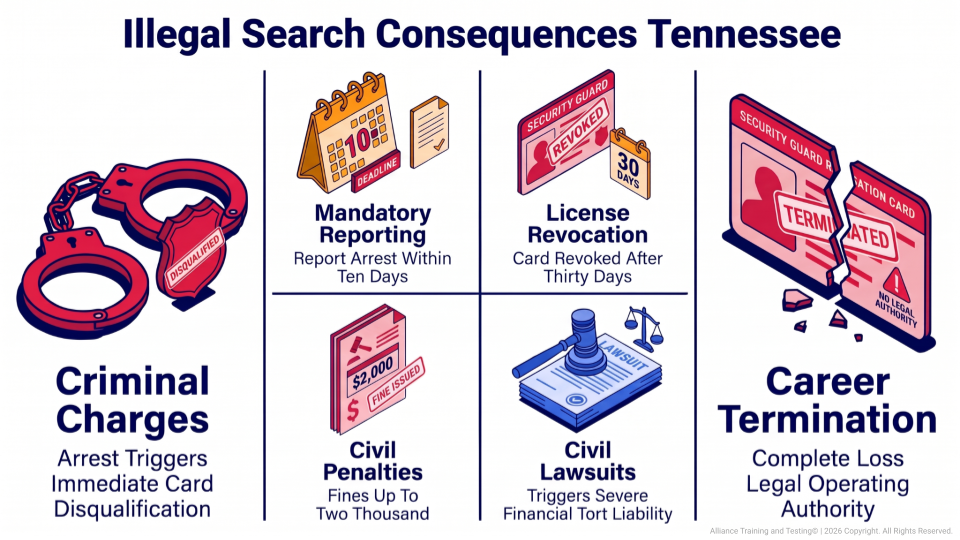
What Happens When a Security Guard Conducts an Illegal Search in Tennessee?
Crossing your legal boundaries during a search or detention triggers a chain reaction under Tennessee law that can end your career within days:
- Criminal Charges & Automatic Disqualification: Grabbing a patron or locking them in a room can result in arrest for Assault, Aggravated Assault, False Imprisonment, Kidnapping, or Robbery. Any felony conviction—or any misdemeanor conviction involving assault and battery, violence against persons or property, theft, or shooting a weapon—disqualifies you from holding a Tennessee security guard registration card (T.C.A. § 62-35-117(4)).
- Mandatory 10-Day Arrest Reporting Rule: Under Tennessee's strict 2026 compliance laws, if you are arrested or cited for any disqualifying offense (or become subject to an order of protection or bond condition restricting firearm possession), both you and your employer must submit written notice and charging documents to the Commissioner of Commerce and Insurance within ten (10) days (T.C.A. § 62-35-120(b) & § 62-35-124(b)).
- License Revocation & $2,000 Fines: The Commissioner can suspend or revoke your registration card and assess civil penalties of up to $2,000 per violation for engaging in dishonorable, unethical, or unprofessional conduct likely to harm the public (T.C.A. § 62-35-130(a)(6)). If you are convicted of a disqualifying offense, your registration card is automatically revoked after 30 days unless you request a formal hearing (T.C.A. § 62-35-130(b)).
- Civil Lawsuits Against You and Your Employer: Why does Tennessee require every security company to carry at least $300,000 in bodily/personal injury liability insurance and $100,000 in property damage insurance with specific endorsements for false arrest, libel, slander, and invasion of privacy (T.C.A. § 62-35-114)? Because illegal searches and bad detentions are the #1 drivers of civil lawsuits in the security industry. Furthermore, even if an action is defended in criminal court, civil remedies remain unaffected unless strict statutory self-defense immunity applies (T.C.A. § 39-11-605 & § 39-11-622).
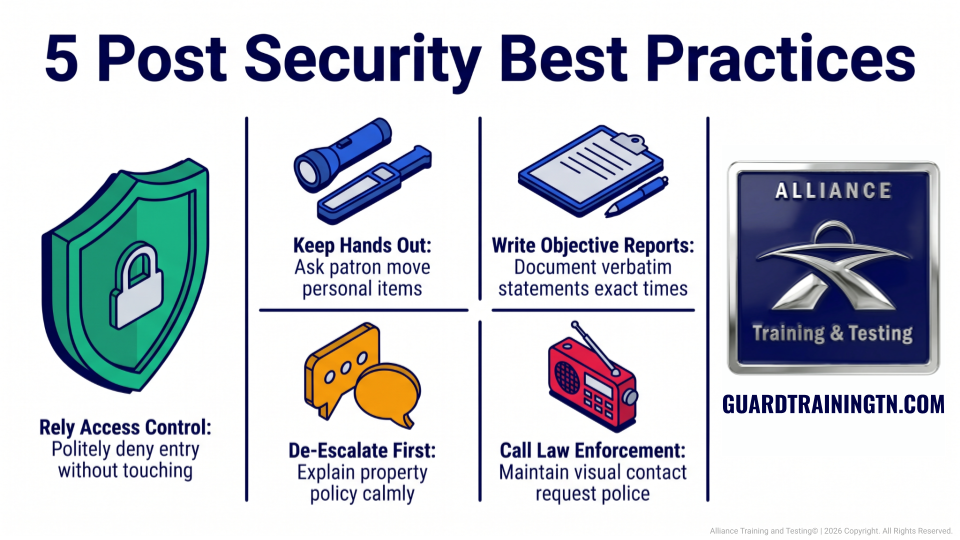
5 Best Practices for Tennessee Security Officers on Post
- Rely on Access Control, Not Force: Use clear entrance signage and verbal communication. If a visitor refuses a bag inspection at a gate or door, politely deny entry. Never touch the bag or the visitor.
- Keep Your Hands Out of Bags: During consensual bag checks, use a small inspection stick or flashlight and ask the patron to open compartments and move items themselves. This protects you from both sharp hazards and false accusations of theft.
- De-Escalate First: Use the verbal de-escalation protocols mandated under T.C.A. § 62-35-118. A calm explanation of property policy resolves 95% of checkpoint disputes.
- Write Detailed, Objective Incident Reports: Field note-taking and report writing are core tested competencies in Tennessee (TN Rule 0780-05-02-.07(2)(b)(2)). Document exact times, witness names, camera angles, what was said verbatim, and how consent was requested and granted (or refused).
- Observe, Report, and Call Law Enforcement: If you suspect someone is carrying an illegal weapon, stolen goods, or contraband and refuses to cooperate, stay at a safe distance, maintain visual contact if safe, and call local police. Let sworn officers with a statutory warrant and Terry authority conduct the search.
Frequently Asked Questions (FAQ)
1. Can a security guard in Tennessee legally search my bag or backpack?
Only with your voluntary consent. A private security guard in Tennessee has no legal authority to force open or search your bag without permission. However, private venues, stadiums, bars, and workplaces can make a bag check a condition of entry onto private property (T.C.A. § 62-35-102(18)). If you refuse the search, the security guard cannot search your bag, but they can legally deny you entry or require you to leave the premises.
2. Can a Tennessee security guard pat me down or frisk me?
No, not without your explicit permission. Unlike sworn police officers who can perform a Terry frisk based on reasonable suspicion that a person is armed, private security guards are private citizens and have no right to touch or pat down your body without consent. Doing so without permission can constitute assault and battery. Security checkpoints may require you to consent to a magnetometer, handheld wand scan, or pat-down as a condition of entering a private event, which you have the right to refuse by leaving the venue.
3. Can a security guard detain someone in Tennessee?
Yes, but only under very strict statutory conditions. First, under Tennessee's Merchant's Privilege law (T.C.A. § 40-7-116), a retail security guard acting as a merchant's agent may detain a suspect with probable cause of shoplifting in a reasonable manner for a reasonable time to investigate or wait for police. Second, under T.C.A. § 40-7-109, a private person may make a citizen's arrest for a public offense committed in their presence or a felony, and must deliver the person to police or a magistrate without unnecessary delay (T.C.A. § 40-7-113). (Note: Temporary event guards working under a Special Event Permit have zero arrest authority under T.C.A. § 62-35-105(d)(1)(C).)
4. Can a security guard search my car or stop me on a road in Tennessee?
No. A security guard cannot open your car door, trunk, or glove box without your voluntary consent. Occupied vehicles in Tennessee carry heightened legal protections similar to a personal residence (T.C.A. § 39-11-611(c)). Furthermore, under Tennessee Attorney General Opinion No. 03-022, private security guards have no authority to stop vehicles or direct traffic on public streets. Security guards are limited to the "Plain View" rule on private property—they may look through the windows from the outside while patrolling a private lot and report any visible weapons or illegal activity to the police.
5. Do private security guards working at government buildings or private colleges have police search powers in Tennessee?
No. According to Tennessee Attorney General Opinion No. 03-022, private security officers employed by a contract security company do not gain police powers and are not exempt from state licensing under T.C.A. Title 62, Chapter 35, even when contracted to guard federal, state, or local government facilities. Similarly, under Tennessee Attorney General Opinion No. 06-146, private college security guards operate under Proprietary Security Organization rules (T.C.A. § 62-35-123) with private citizen search limits, unless they hold a specific law enforcement commission as a "Special Police Officer" (T.C.A. § 62-35-103(a)(14)).
6. What happens to evidence if a private security guard searches me illegally?
Unlike an illegal police search—where evidence is thrown out under the Fourth Amendment's "fruit of the poisonous tree" exclusionary rule—evidence found by a private security guard acting independently of the police is often still admissible in court (Burdeau v. McDowell). However, the security guard and their employer face severe penalties, including criminal charges (assault, false imprisonment, theft), civil lawsuits for invasion of privacy and false arrest (T.C.A. § 62-35-114), and revocation of their Tennessee security license (T.C.A. § 62-35-130).
Ready to Get Certified or Upgrade Your Tennessee Security Guard Registration?
Whether you need your initial 4-Hour Unarmed Security Guard Training, 16-Hour Total Armed Guard Certification (4-Hr General + 12-Hr Firearms), Dallas' Law De-Escalation & Restraint Training, or Unarmed License Renewal and On-Site Unarmed Guard training, our state-certified trainers (T.C.A. § 62-35-126) deliver 100% compliant instruction tailored to current Tennessee law.
Explore Our Certified Tennessee Security Training Courses Today!
🚨 TN Security Guard Search & Seizure Laws: The Complete Audio Briefing (2026) | @guardtrainingtn