
A call comes in—a disturbance, a break-in, an incident. As a private security professional, you arrive first. The scene is quiet, the air is thick with tension, and what you do in the next few minutes could determine the outcome of an entire criminal prosecution. For professionals undergoing Tennessee security guard training, understanding how to secure a potential crime scene without contaminating evidence is a core responsibility regulated under the Private Protective Services Licensing and Regulatory Act (T.C.A. § 62-35-101 et seq.).
What Are the Legal Crime Scene Protocols for a Tennessee Security Guard in 2026 @guardtrainingtn
Quick Answer: What is a Tennessee Security Guard’s Legal Duty at a Crime Scene?
Under Tennessee law (T.C.A. § 62-35-102), a security guard’s duty is to protect people and property by preventing, observing, and detecting unauthorized or criminal activity on private property. Unlike sworn police officers—who have a government mandate to investigate and prosecute crimes—a private security officer’s role at a crime scene is strictly limited to scene preservation, perimeter control, field note-taking, and turning over control to arriving law enforcement.
Private Security Response Role vs. Law Enforcement in Tennessee
Long before the yellow tape of a police-secured perimeter goes up, a security guard is the first line of defense. However, operating legally in Tennessee requires understanding the boundary between private security duties and public law enforcement authority.
- The Role of Private Security: Your legal authority covers detecting intrusion, theft, vandalism, fire, or trespass, and directing public flow on private property.
- The Role of Law Enforcement: Only a sworn government peace officer holds the legal authority to formally investigate crimes, execute search warrants, and prosecute offenses.
- Strict Rules Against Impersonating Police: Tennessee law (T.C.A. § 62-35-134) strictly prohibits security guards from acting like sworn peace officers, wearing badges or uniforms that mimic local police, or implying they are government investigators. Crossing this line can result in license revocation and civil penalties of up to $2,000 per violation.
Your job at a crime scene is never to play detective or collect evidence. Instead, your duty is to freeze the scene in time so forensic specialists can reconstruct events and ensure all physical evidence remains admissible in a Tennessee court.
Core Principles of Crime Scene Preservation
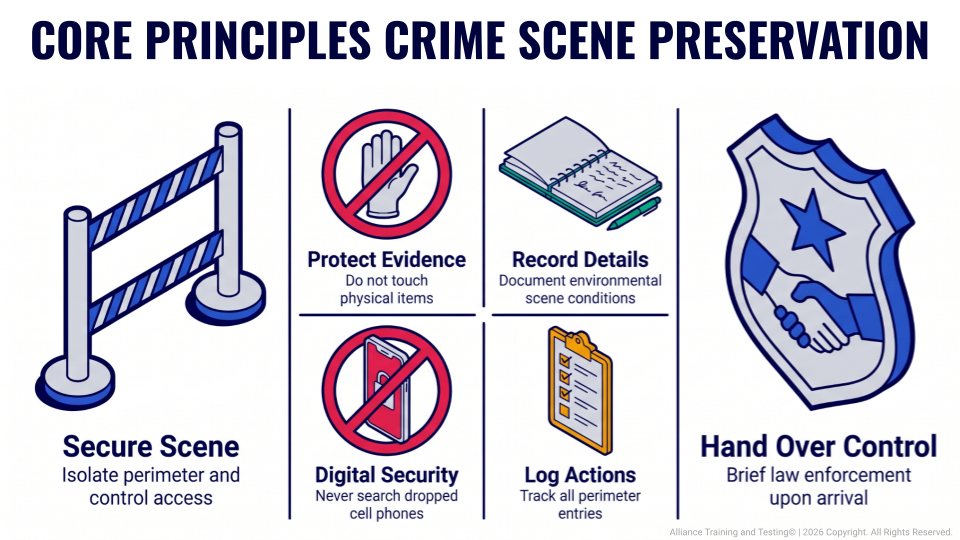
Effective crime scene preservation is built on four non-negotiable principles drilled into recruits during state-certified training under T.C.A. § 62-35-118.
Principle 1: Secure the Scene Immediately
When you discover a crime scene, your priority is to isolate the area. In Tennessee, registered security guards have explicit authority to control and direct public movement on private property, and property protection laws allow reasonable, non-deadly force to stop unlawful trespass or interference with the premises.
- Isolate the Area: Use stanchions, caution tape, vehicles, furniture, or your physical presence to create a clear boundary.
- Control Access: Only allow emergency medical personnel inside the perimeter if there are injured individuals. Keep everyone else—including bystanders, tenants, and curiosity-seekers—out.
- Protect Entry and Exit Paths: The crime scene includes not just the primary incident area, but also all probable entry and flight paths the suspect used.
Principle 2: Protect and Preserve Physical & Digital Evidence
Under the Tennessee Rules of Evidence, physical items must be strictly authenticated to be used in court. If a security guard moves, bags, or handles an item, defense attorneys can challenge the chain of custody and have the evidence thrown out.
- Do Not Touch Anything: Never pick up, move, or "clean" any object, shell casing, or weapon unless an immediate, life-threatening safety hazard requires it.
- Never Search Dropped or Seized Cell Phones: Tennessee law (T.C.A. § 40-6-110) places strict warrant requirements on searching or extracting cell phone data, and illegally accessed data is inadmissible in court. If a suspect drops a phone, leave it untouched and guard it until police arrive.
- Be Mindful of Your Path: Establish a single path of approach and exit to avoid stepping in bloodstains, tire tracks, or footprints.
- Guard Against the Elements: If outdoors, shield fragile evidence from rain, wind, or foot traffic (for example, placing a clean box over a footprint without touching the print itself).
Principle 3: Observe and Document Everything
Memory under stress is fallible, and your written records can be subpoenaed for trial. In fact, field note-taking and report writing are mandatory core competencies tested by the Tennessee Department of Commerce and Insurance.
- Record Environmental & Scene Details: Log the exact time of discovery, weather conditions, lighting, whether doors were open or locked, and any unusual smells (such as gunpowder, accelerants, or alcohol) or sounds.
- Identify Witnesses: Gather names, phone numbers, and physical descriptions of anyone present when you arrive so detectives can interview them.
- Log Your Own Actions: Write down every step you took to secure the perimeter and note whether you or EMS had to move anything to render lifesaving aid.
Principle 4: Communicate and Hand Over Control to Law Enforcement
You are the eyes and ears for responding police officers before they arrive.
- Provide a Concise, Factual Briefing: Meet the first responding officers at the perimeter edge. Give them a chronological summary of observations, suspect descriptions, direction of flight, and your scene log.
- Keep Your Guard Card Accessible: While interacting with arriving officers, ensure your state registration card (and any less-than-lethal weapon certification cards) are on your person, as Tennessee law requires you to carry them on duty and present them to law enforcement upon request.
- Remain Available: Once police assume command, step back outside the perimeter, stay on-site to answer follow-up questions, and keep your original field notes safe in case you are called to testify in court.
Step-by-Step Guide: First Responder Protocol for Tennessee Guards
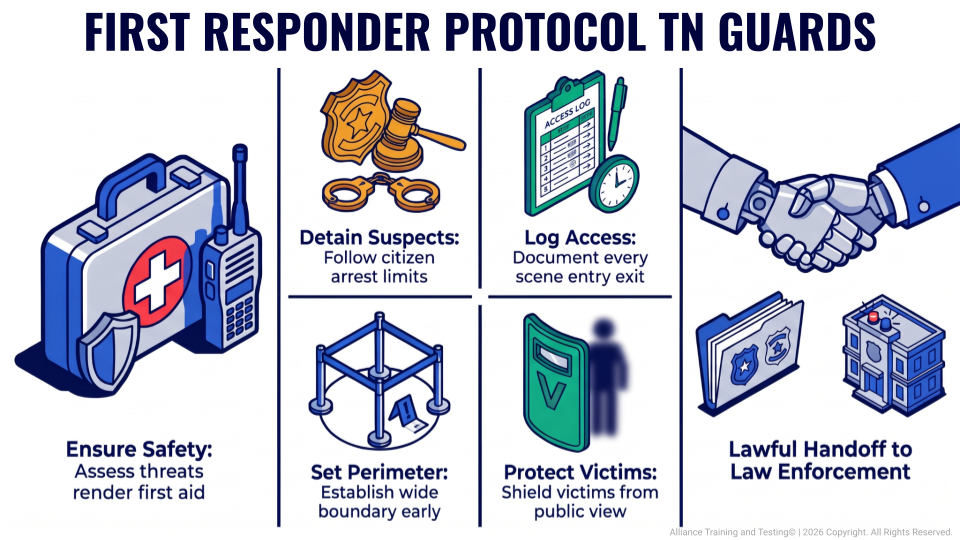
When responding to an active incident or discovering a crime scene, follow this practical sequence:
- Ensure Personal Safety & Render Lifesaving Aid: Assess the scene for active threats or hazards like fire, gas leaks, or armed suspects. Use reasonable force only when immediately necessary to protect yourself or others from imminent harm. If a victim is injured, render First Aid or CPR while disturbing the surrounding area as little as possible.
- Detain Suspects Only Within Citizen's Arrest Limits: If the suspect is still on-site, remember that private security guards do not have police arrest powers. Under Tennessee's citizen's arrest statute (T.C.A. § 40-7-109), you may detain someone only for a public offense committed in your presence, or when a felony has been committed, and you have reasonable cause to believe that person committed it. You must inform the suspect of the reason for the detention and turn them over to law enforcement without unnecessary delay. (Note: Temporary guards working under a Special Event Permit have zero arrest authority).
- Establish a Wide Perimeter: Set a boundary larger than you think is necessary. Police can easily shrink a perimeter later, but they cannot decontaminate a scene that was set too small.
- Initiate a Crime Scene Access Log: Document every individual who enters or exits the secured perimeter, including EMS, supervisors, and arriving officers. Record their name, badge or agency number, entry time, and exit time.
- Protect Victims' Rights: Under the Tennessee Victims' Rights Act, crime victims have the right to be treated with fairness, dignity, and respect, and to be free from harassment. Shield injured or traumatized victims from bystanders and the media while awaiting police and EMS.
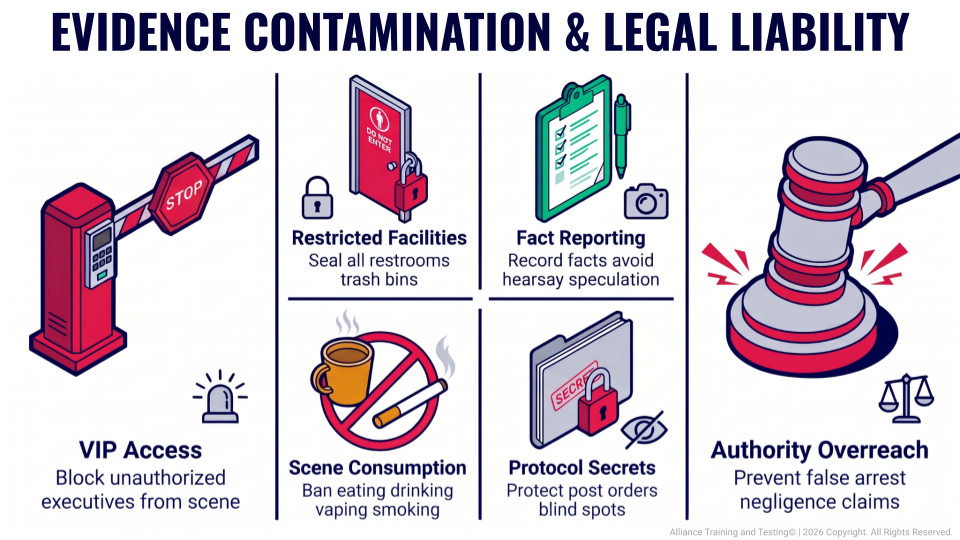
Common Mistakes That Cause Evidence Contamination & Legal Liability
Preventing evidence contamination and civil liability is about knowing what not to do on post:
- Allowing "VIP" Access: Property managers, corporate executives, or venue owners often demand to walk through a crime scene to "assess the damage". Politely but firmly deny them entry. Explain that entering the scene compromises criminal evidence and exposes the business to liability.
- Using a Restroom, Sink, or Trash Can: Suspects frequently wash blood off their hands, flush narcotics, or discard weapons in restrooms and bins. Declare all nearby facilities strictly off-limits.
- Eating, Drinking, Vaping, or Smoking: Dropping ash, gum, or condensation introduces foreign DNA into the crime scene.
- Engaging in Hearsay and Speculation: Hearsay is generally inadmissible in Tennessee courts. Stick strictly to objective facts (what you saw, heard, and smelled) in your incident report and police briefing. Never speculate or share theories with witnesses or the media.
- Divulging Confidential Security Protocols: Tennessee law makes it illegal for a security guard to divulge confidential security protocols. Keep post orders, camera blind spots, and client security procedures strictly between your company and investigating officers.
- Risking False Arrest & Negligence Lawsuits: Because security companies must carry substantial liability insurance covering false arrest, negligence, slander, and invasion of privacy (T.C.A. § 62-35-114), overstepping your authority at a crime scene can trigger costly lawsuits against both you and your employer.
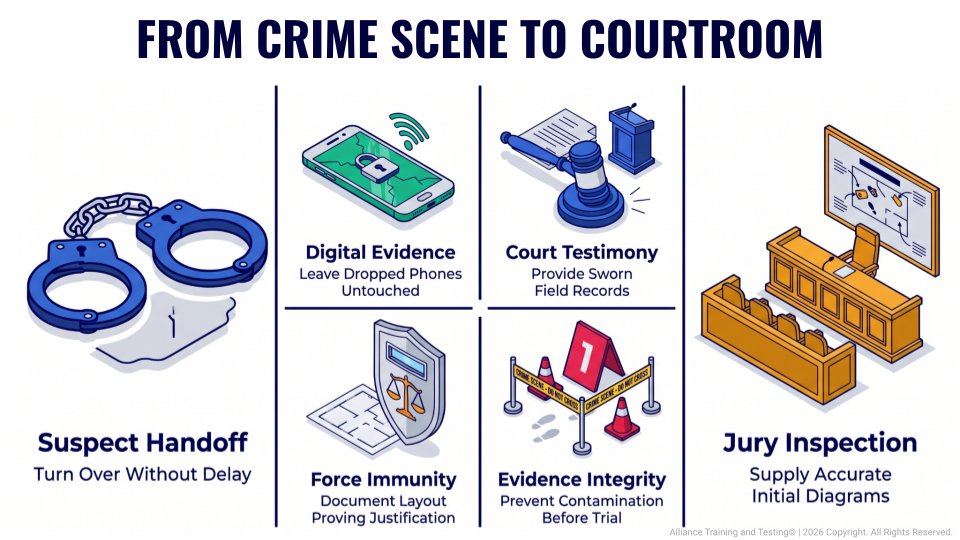
From Crime Scene to Courtroom: How Your Actions Impact a Criminal Case
Every action a security officer takes in the first fifteen minutes at a crime scene directly affects how a case moves through Tennessee's criminal justice system (T.C.A. Title 40). Understanding the lifecycle of a criminal case shows why state-certified Tennessee security guard training emphasizes precision, restraint, and documentation:
Frequently Asked Questions
What is the most important duty of a security guard at a crime scene in Tennessee?
The most important duty of a security guard at a crime scene is to ensure safety and immediately establish a secure perimeter to prevent unauthorized entry and contamination of evidence. Under T.C.A. § 62-35-102(18), Tennessee security guards may control public movement on private property and observe and report criminal activity until sworn law enforcement officers arrive and take command.
Can a private security guard collect evidence or search a suspect's phone in Tennessee?
No. Only sworn law enforcement officers and forensic technicians may collect, bag, or move physical evidence. Furthermore, under T.C.A. § 40-6-110, even police officers may not search cell phone data without a search warrant, informed consent, or exigent circumstances. A security guard should never touch physical or digital evidence, as doing so breaks the chain of custody and can make the evidence inadmissible in court.
Can a security guard detain a suspect at a crime scene in Tennessee?
A Tennessee private security guard does not have police arrest powers. However, a registered guard has the same citizen's arrest authority as a private person under T.C.A. § 40-7-109, which allows detention only if a public offense is committed in the guard's presence, or if a felony has been committed and the guard has reasonable cause to believe the suspect committed it. A guard may use only the force reasonably necessary to make a lawful detention and cannot use deadly force unless justified under Tennessee’s self-defense or defense of a third person laws. Once detained, the suspect must be turned over to law enforcement without unnecessary delay.
What documentation must a Tennessee security guard maintain at a crime scene?
A security guard must take detailed field notes and write a factual incident report. This documentation should include the exact time of arrival, environmental conditions, the scene's initial appearance, the names and contact information of witnesses, a crime scene access log recording everyone who entered or exited the perimeter, and a chronological summary of all actions the guard took.
Can a Tennessee security guard be subpoenaed to testify in court about a crime scene?
Yes. Under T.C.A. § 40-17-201, a Tennessee court can issue a subpoena requiring a security guard to attend court, give sworn testimony, and produce field notes, incident logs, or other documentation. Failing to obey a lawful subpoena without a valid excuse is punishable as contempt of court.
Start Your Tennessee Security Guard Training Today
Ready to build the legal knowledge and tactical skills that matter when seconds count? From mastering Legal Powers and Limitations and Emergency Procedures (T.C.A. § 62-35-118) to courtroom-ready Field Note-Taking and Report Writing, state-approved training is your foundation for a successful security career.
Enroll in our state-certified Tennessee security guard training courses today and become an indispensable asset to public safety and law enforcement across Tennessee.
Crime Scene Protocols TN Security Guards - The Complete Audio Briefing (2026) @guardtrainingtn