

In Tennessee, private security guards lack police powers; their arrest authority matches that of an ordinary private citizen under Tennessee's citizen's arrest law (T.C.A. § 40-7-109). A registered security guard may lawfully make a citizen’s arrest only when a public offense (misdemeanor or felony) is committed directly in their presence, or when a felony has been committed and the guard has reasonable cause to believe the suspect committed it.
Tennessee Security Guard Arrest Powers Legal Guide
Imagine you are on patrol during a late-night shift and witness vandalism or theft. The line between a lawful detention and a career-ending lawsuit for false imprisonment or criminal assault is razor-thin. Understanding Tennessee security guard arrest powers is essential to protecting yourself, your employing security company, and the public.
Below is a practical breakdown of Tennessee citizen’s arrest laws, proper detention procedures, use-of-force limitations, and the official Tennessee Attorney General Opinion governing stops, questioning, and arrests on private property.
Security Guard vs. Law Enforcement Officer: What is the Legal Difference in Tennessee?
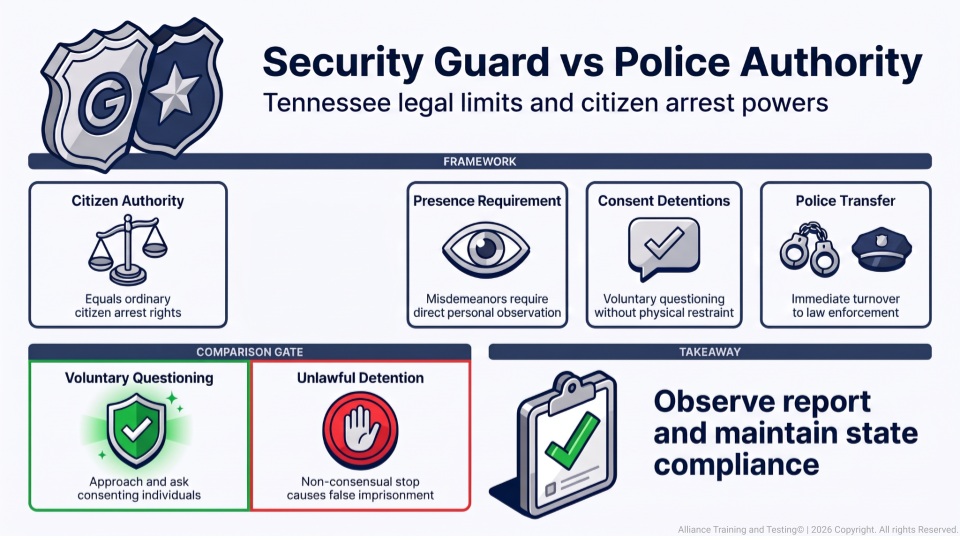
A sworn law enforcement officer is a government agent empowered by state law to make warrantless arrests based on probable cause for both felonies and misdemeanors. Conversely, a private security guard operates as a private citizen regulated by the Private Protective Services Licensing and Regulatory Act (T.C.A. Title 62, Chapter 35).
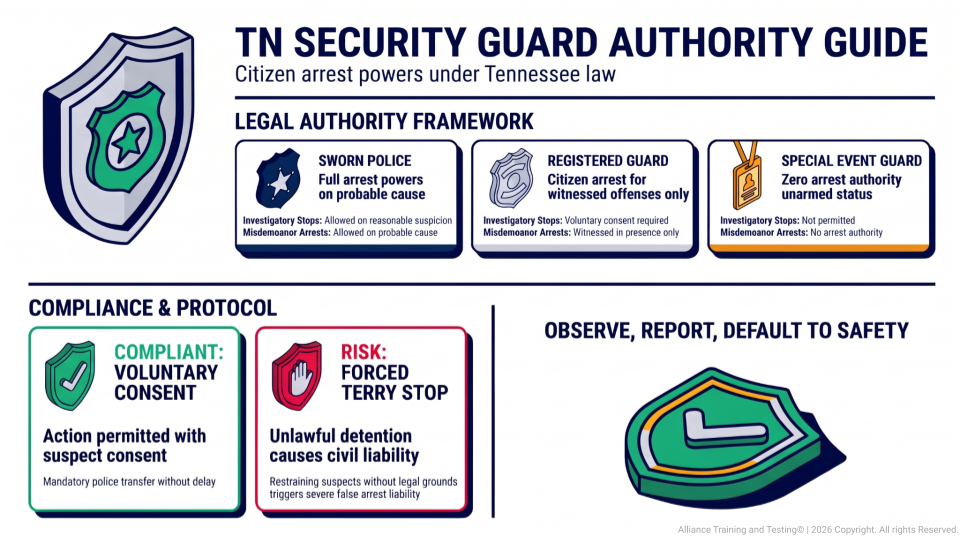
A security officer is not a peace officer. State law strictly prohibits security guards from acting as sworn peace officers, displaying the word "Police" on badges or vehicles, or using any statement or insinuation that would lead a reasonable person to believe they are a government official.
Furthermore, temporary security guards hired under a Special Event Permit (valid for up to 10 days a year) must be unarmed and have no arrest authority.
When Can a Security Guard Make a Citizen's Arrest in Tennessee?
Under the Tennessee citizen's arrest statute (T.C.A. § 40-7-109), a private person—including a licensed security guard—may lawfully arrest another individual under three specific grounds:
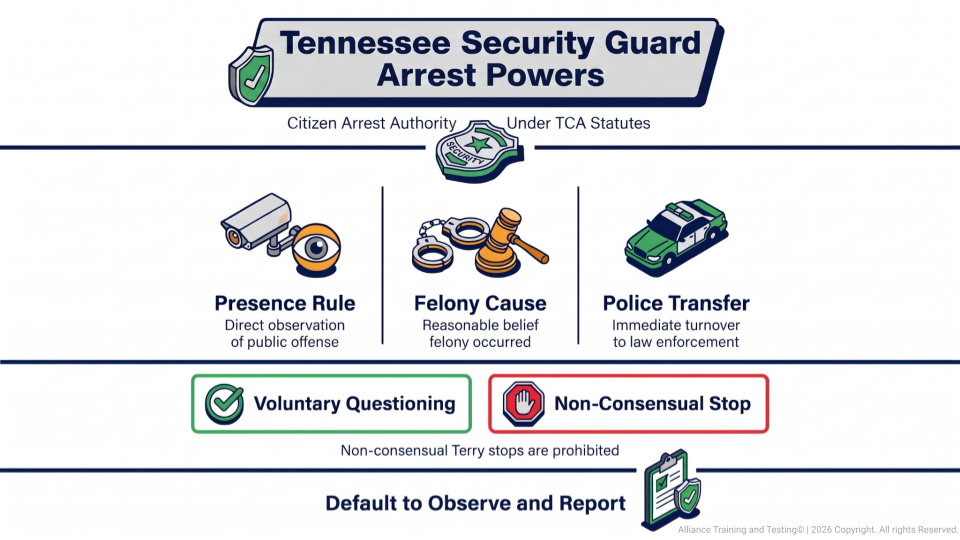
- For a public offense committed in your presence: "Public offense" includes both felonies and misdemeanors (such as criminal trespass, vandalism, assault, or theft).
- When the person arrested has committed a felony, even if not in your presence: The arrest is valid if the person actually committed a felony offense (crimes punishable by one year or more of confinement).
- When a felony has been committed, and you have reasonable cause to believe the person arrested committed it, state law allows a private person to arrest for a felony at any time of day or night.
What Does the "In Your Presence" Rule Mean for Misdemeanors?
For any misdemeanor, you cannot arrest someone based on hearsay, a witness report, or a hunch. "In your presence" means you must directly perceive the criminal act through your own senses.
If a coworker or bystander tells you, "That person just vandalized a car in the parking lot," you cannot legally arrest the suspect for misdemeanor vandalism because you did not witness it. Your only lawful course of action is to observe and report: gather a physical description, note the direction of travel, and call local law enforcement.
The Retail "Merchant's Privilege" Nuance
While general citizen’s arrest law requires a misdemeanor to be committed in your presence, Tennessee law provides a specific exception for retail theft (T.C.A. § 40-7-116). Under this rule, a merchant, a merchant's agent, or a peace officer with probable cause to believe a theft has occurred or is about to occur may detain a suspect for a reasonable time to investigate. Additionally, plainclothes loss prevention specialists employed directly by a retailer are exempt from state security guard registration requirements, provided they never carry a weapon or wear a security uniform.
Proper Detention Procedure: What Must a Guard Do After Making an Arrest?
Making a lawful citizen's arrest is only the first step. To keep the detention legal when detaining suspects in Tennessee, a security guard must strictly follow three statutory procedures:
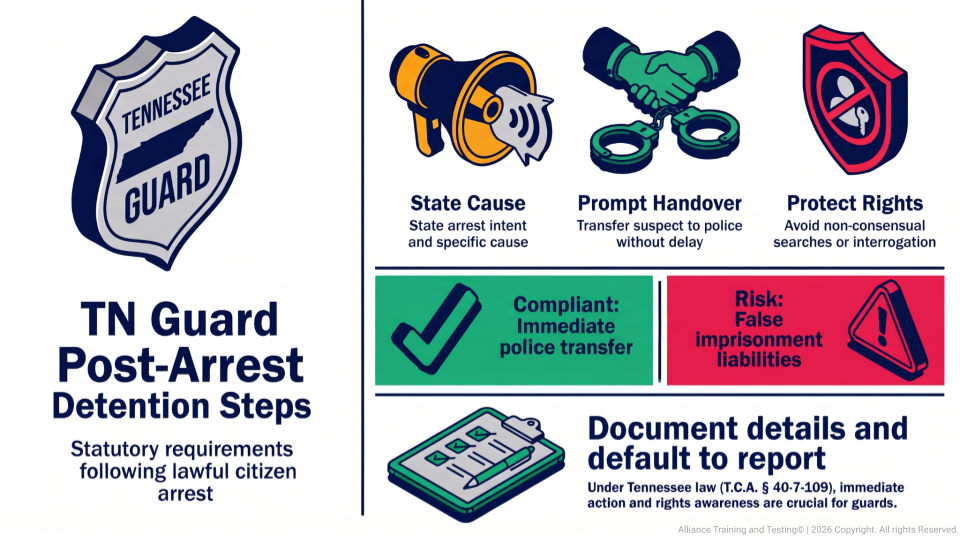
- Inform the Suspect of the Arrest and Cause: Under Tennessee law (T.C.A. § 40-7-111), you must tell the suspect you intend to arrest them and state the specific reason.
- Exception: You do not need to state the cause if the suspect is caught during the actual commission of the crime or is pursued immediately after escaping.
- Deliver to Law Enforcement Without Unnecessary Delay: State law (T.C.A. § 40-7-113) requires a private citizen who arrests another to take the person before a magistrate or turn them over to a sworn law enforcement officer without unnecessary delay. When a police officer takes custody of a person arrested by a private citizen for a misdemeanor, the officer will generally issue a citation instead of continuing custody unless specific exceptions apply.
- Do Not Interrogate or Search Without Consent: Security guards have no legal authority to conduct non-consensual searches or hold suspects against their will for investigative questioning. Even sworn police officers are barred from searching cell phone data without a warrant or consent, and strip searches are heavily restricted by state law.
Important Note on Pursuit and Entry: While Tennessee statutes technically allow a private person to break open a door or window to make an arrest if refused admittance after giving notice, or to immediately pursue an escaped arrestee, private security company post orders universally prohibit guards from chasing suspects off client property or forcing entry into buildings due to extreme safety and liability risks.
Use of Force and the Tennessee Attorney General’s Opinion on Stops, Detentions, and Arrests
Under Tennessee's private citizen use-of-force law (T.C.A. § 39-11-621), a security guard making a lawful arrest may use only the force "reasonably necessary to accomplish the arrest of an individual who flees or resists the arrest." A private citizen cannot use or threaten deadly force simply to stop a fleeing suspect.
1. Non-Deadly Force and Property Protection
- Protection of Property: Under state law, a person in lawful possession of property—or a guard protecting a client's property—is justified in threatening or using non-deadly force when and to the degree reasonably believed immediately necessary to prevent or stop a trespass or unlawful interference with the property.
- Confinement as Justifiable Force: Restraining or confining someone is legally justified when force is justified, provided the guard takes reasonable steps to end the confinement as soon as it is safe to do so, unless the person has been lawfully arrested for a crime.
2. Strict Limits on Deadly Force
A private security guard cannot use or threaten deadly force unless authorized under Tennessee's self-defense laws:
- Self-Defense & Defense of Others: A guard who is acting lawfully and is in a place where they have a right to be has no duty to retreat before using deadly force only if they have a reasonable belief—founded on reasonable grounds—that there is an imminent danger of death, serious bodily injury, or grave sexual abuse to themselves or a third person. (Only federally regulated nuclear security officers at Category I nuclear facilities have expanded statutory deadly force authority.)
- Civil Immunity & Bystander Liability: If a guard uses force legally in self-defense or to protect property, Tennessee law grants immunity from civil liability (including recovering attorney's fees if a civil suit is dismissed). However, this immunity does not protect you from criminal prosecution or civil lawsuits if you recklessly injure or kill an innocent bystander.
3. Tennessee Attorney General’s Opinion on Security Guards and Arrests (Opinion No. 04-006)
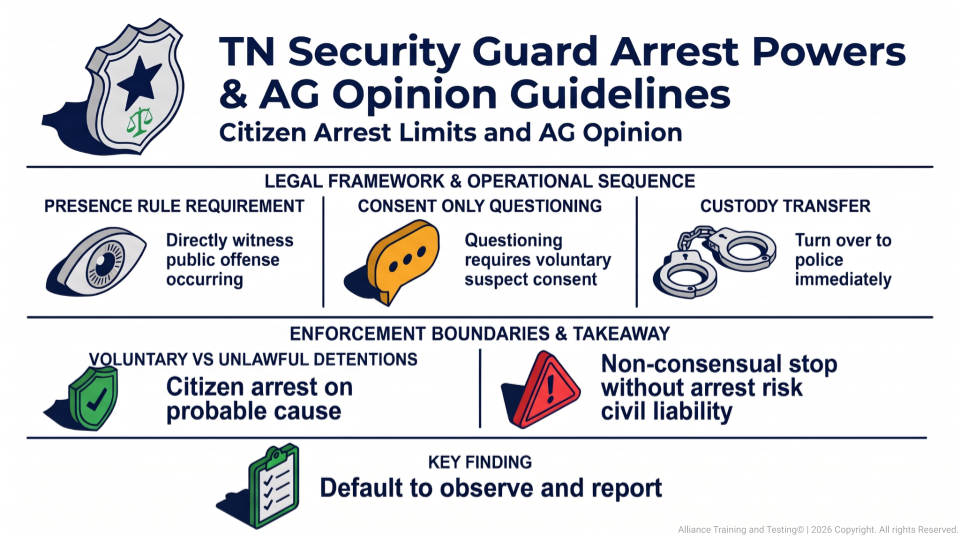
To clarify the legal boundaries for armed and unarmed state-certified security officers protecting private property and assets, the Tennessee Office of the Attorney General issued Opinion No. 04-006 (building on Opinion No. 03-018). The Attorney General’s analysis establishes four foundational rules that every Tennessee security guard must follow:
- Identical Arrest Authority to Private Citizens: Relying on Tennessee Supreme Court precedent, the Attorney General reaffirmed that state-certified security officers have the exact same arrest powers as ordinary private citizens. Security guards are explicitly denied the powers of sworn police officers and cannot arrest "under color of government."
- Right to Stop and Question on Private Property (Consent Only): Because Tennessee law authorizes security guards to prevent, observe, and detect unauthorized activity—such as intrusions, theft, vandalism, fire, or trespass—and to enforce rules and laws on private property, a security guard does have the right to approach, stop, and ask probing questions of a suspicious person on the property they are hired to protect. However, unless the person is arrested, any questioning must remain voluntary and with the suspect's consent.
- No Authority for Non-Consensual Investigatory "Terry" Stops: While sworn police officers can briefly detain a suspect against their will for questioning based on "reasonable suspicion" (known as a Terry stop), the Attorney General ruled that no legal authority permits security guards to conduct non-consensual investigatory stops. Unless the retail merchant's theft privilege applies, a security guard cannot force a suspect to remain for questioning against their will. To hold a person without consent, the guard must lawfully place the suspect under citizen's arrest based on probable cause supported by facts.
Stopping Vehicles on Private Property: Tennessee law authorizes security guards to "control, regulate, or direct the flow or movements of the public, whether by vehicle or otherwise on private property." Therefore, a security guard may stop a vehicle on private property for trespassing or any other law violation the guard observes. However, the guard cannot detain the driver without consent. The guard must either expel the trespasser from the private property or place the suspect under citizen's arrest on probable cause (and may use reasonably necessary force if the arrested suspect flees or resists).
Avoiding False Imprisonment and Licensing Penalties
False imprisonment occurs when a security guard intentionally restrains another person’s freedom of movement without legal authority or consent. Because Tennessee law recognizes the high risk of improper detentions, all licensed contract security companies and proprietary security organizations are required to maintain general liability insurance of at least $300,000 for bodily/personal injury and $100,000 for property damage, with explicit coverage for false arrest, libel, slander, and invasion of privacy.
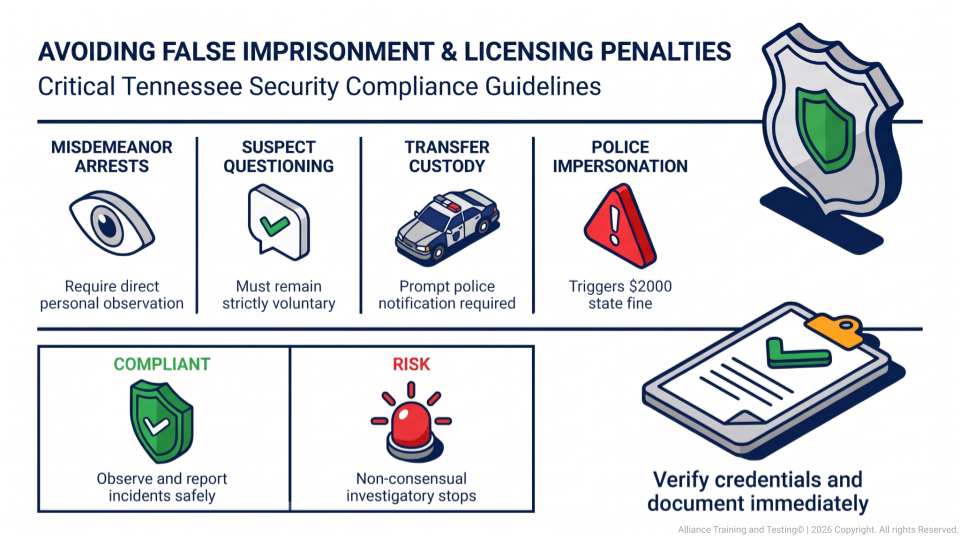
4 Common Mistakes That Lead to Lawsuits and License Revocation
- Conducting Non-Consensual Investigatory Stops: Forcing a suspicious person or vehicle to stay on site for questioning without a valid citizen's arrest.
- Detaining Without Witnessing a Misdemeanor: Stopping a person based on a hunch or a third-party complaint rather than personal observation.
- Unreasonable Delay in Calling Police: Holding a suspect in a back office to "investigate" or lecture them instead of immediately transferring custody to law enforcement.
- Impersonating Law Enforcement or Failing to Report Arrests: Using language, badges, or equipment that implies police authority is unlawful and can trigger up to a $2,000 civil penalty per violation or license revocation. Additionally, if a guard is cited or arrested for any disqualifying offense (such as assault, theft, or unlawful weapon use), both the guard and their employer must notify the state in writing within 10 days.
Best Practices for Tennessee Security Professionals
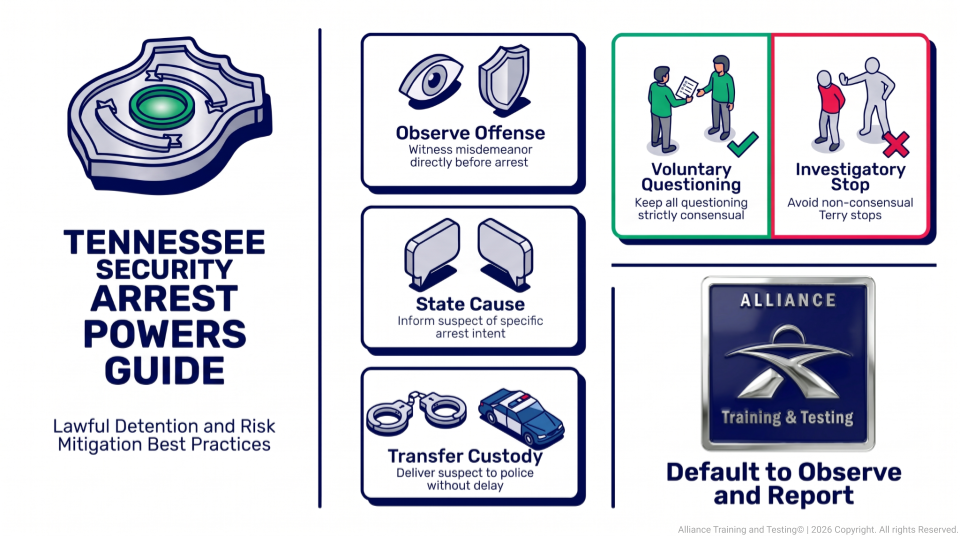
- Default to "Observe and Report" or Property Expulsion: As noted in Attorney General Opinion 04-006, as the agent entrusted to protect private property, you may expel trespassers from the premises rather than risk a high-liability physical arrest.
- Keep Questioning Voluntary: Approach suspicious individuals professionally and ask questions without blocking their path or overbearing their will. If they refuse to answer and you lack legal grounds for a citizen's arrest, instruct them to leave the property or call the police.
- Carry Your Credentials on Duty: State regulations require you to keep your active registration card (or, for unarmed applicants, a valid pending application receipt and proof of fees), weapon certification cards, and venue training endorsements on your person at all times while on post.
- Document Every Detail Immediately: If you make a citizen's arrest or use force, write a comprehensive incident report immediately. Record exact timestamps, what you personally observed, when you informed the suspect of the cause for arrest, when you called law enforcement, and the badge numbers of responding officers.
Frequently Asked Questions (FAQ)
Can a Tennessee security guard use handcuffs?
Private Protective Services does not recognize handcuffs as a state-certified weapon or device. Handcuffing someone without lawful grounds for arrest constitutes false imprisonment. A Tennessee security guard may use handcuffs, at their own peril, only if the restraint is reasonably necessary to safely detain a suspect during a lawful citizen's arrest under T.C.A. § 40-7-109 and T.C.A. § 39-11-621.
What is the difference between "detaining" someone and a citizen's arrest in Tennessee?
According to Tennessee Attorney General Opinion No. 04-006, a security guard may not detain a suspect against their will without placing them under arrest. Unlike police officers, who can conduct brief investigatory "Terry" stops based on reasonable suspicion, private security guards cannot force a suspect to remain for questioning without consent. Any non-consensual restraint of a person's liberty (outside of the narrow retail merchant's theft exception) is an arrest and must be justified under Tennessee's citizen's arrest law.
Can a security guard stop my vehicle on private property in Tennessee?
Yes. Under Tennessee law and Attorney General Opinion No. 04-006, a state-certified security guard may stop a vehicle on private property to regulate traffic flow or address trespassing and other law violations within the guard's view. However, the security guard cannot detain you in your vehicle against your will unless they have supportable probable cause to place you under citizen's arrest; otherwise, they may only question you with your consent or expel you from the private property.
Am I protected by my employer's insurance if I am sued for false arrest?
All licensed Tennessee security companies and registered proprietary security organizations must carry at least $300,000 in general liability insurance that specifically includes an endorsement for false arrest. However, this insurance covers negligent acts committed within the course and scope of your employment. If you willfully violate citizens' arrest laws, detain suspects without consent or probable cause, or act outside your company's post orders, you can still face personal civil liability, criminal charges, and disciplinary fines up to $2,000 from the state.
Ready to build the confidence and legal knowledge needed to excel in your security career?
Explore our TDCI-approved Tennessee security guard training courses—including Unarmed, Armed, Dallas Law, and certification renewals —to stay 100% compliant with 2026 state laws.
Alliance Training & Testing
The Security School of Choice in Tennessee
Tennessee Security Guard Authority Guide @GuardTrainingTN