

What is a security guard's legal authority regarding trespassing in Tennessee?
In Tennessee, a registered security guard acts as the property owner's legal agent under the Private Protective Services Licensing and Regulatory Act to prevent, detect, and terminate unauthorized entry or criminal trespass (T.C.A. § 39-14-405) on private property. While security officers are strictly prohibited from acting as or impersonating sworn peace officers, Tennessee law authorizes them to issue formal verbal notices revoking effective consent and to use only the minimum non-deadly force immediately necessary to terminate a trespass.
TN Security Guard's Legal Powers for Trespassing & Use of Force? @guardtrainingtn
Key Statutory Takeaways for Quick Reference:
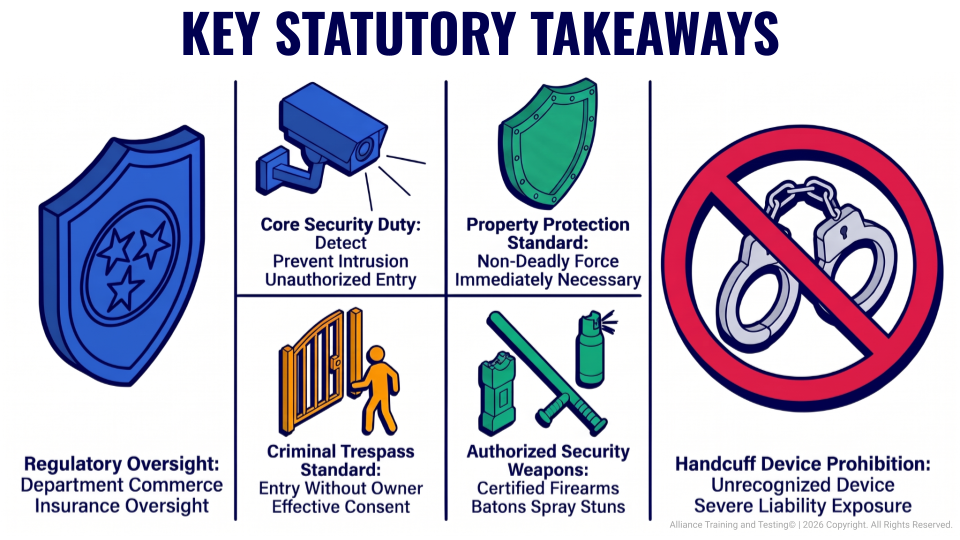
- Governing Regulatory Body: Tennessee Department of Commerce and Insurance, Private Protective Services.
- Core Duty Definition: Preventing or detecting intrusion, unauthorized entry, or trespass on private property (T.C.A. § 62-35-102).
- Criminal Trespass Standard: Entering or remaining on property without the owner's effective consent (T.C.A. § 39-14-405).
- Protection of Property Standard: Non-deadly force is justified only when and to the degree reasonably believed immediately necessary to prevent or terminate trespass (T.C.A. § 39-11-614).
- Authorized Devices & Handcuff Liability: Tennessee Private Protective Services rules recognize only approved firearms, batons, chemical spray, and stun guns as authorized weapons for certified guards. Handcuffs are not recognized as an authorized security device, and using them—even with training—exposes the guard and employer to severe criminal and civil liability, including false arrest, false imprisonment, assault, and battery.
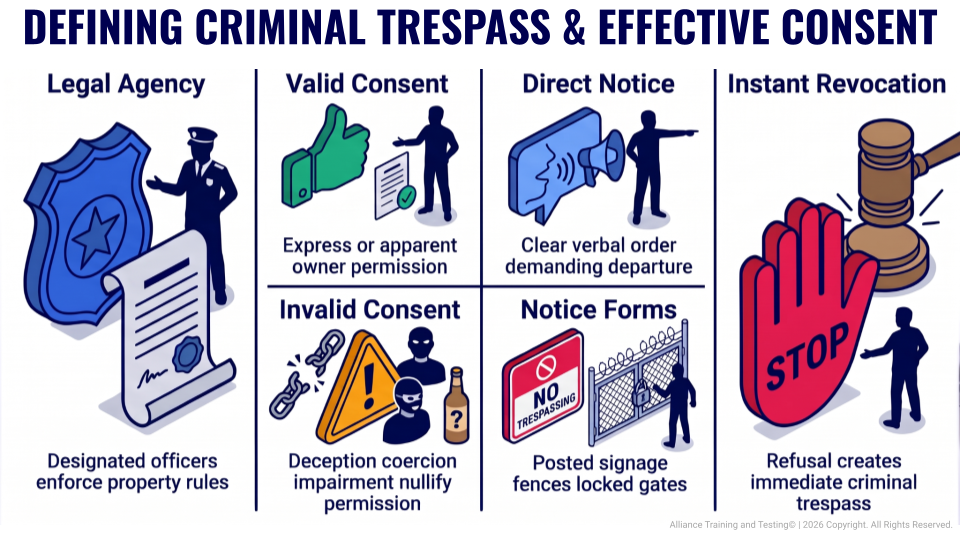
How Does Tennessee Law Define Criminal Trespass and "Effective Consent"?
Under Tennessee Code Annotated (T.C.A.) § 39-14-405, an individual commits criminal trespass when they knowingly enter or remain on property without the owner's effective consent. For a registered security guard, enforcing property rights requires a clear understanding of how Tennessee law defines ownership, consent, and notice.
- Property Owners and Authorized Agents: Under Tennessee's criminal code, an owner is anyone with lawful possession of, or an interest in, a property. Security officers act as designated legal agents of the property owner, carrying the owner's authority to enforce site rules.
- What "Effective Consent" Means: Consent can be express or apparent, including permission granted by a security officer acting for the property owner. However, Tennessee law states that consent is not effective if it is gained through deception or coercion, given by someone without authority, or given by a person unable to make reasonable decisions due to youth, mental defect, or intoxication.
- Revocation of Consent: Permission to be on commercial or private property (such as a retail store, hospital, or entertainment venue) can be revoked at any moment. The instant an authorized security officer asks an individual to leave, and they refuse, that person becomes a trespasser under Tennessee law.
- Three Legal Forms of Notice in Tennessee:
- Direct Verbal or Written Communication: A clear directive from the property owner or security guard ordering the person to leave the premises.
- Posted Signage: Clearly visible "No Trespassing" or "Restricted Area" signs placed at entry points.
- Physical Barriers: Fences, walls, locked gates, or other enclosures designed to keep unauthorized intruders out.
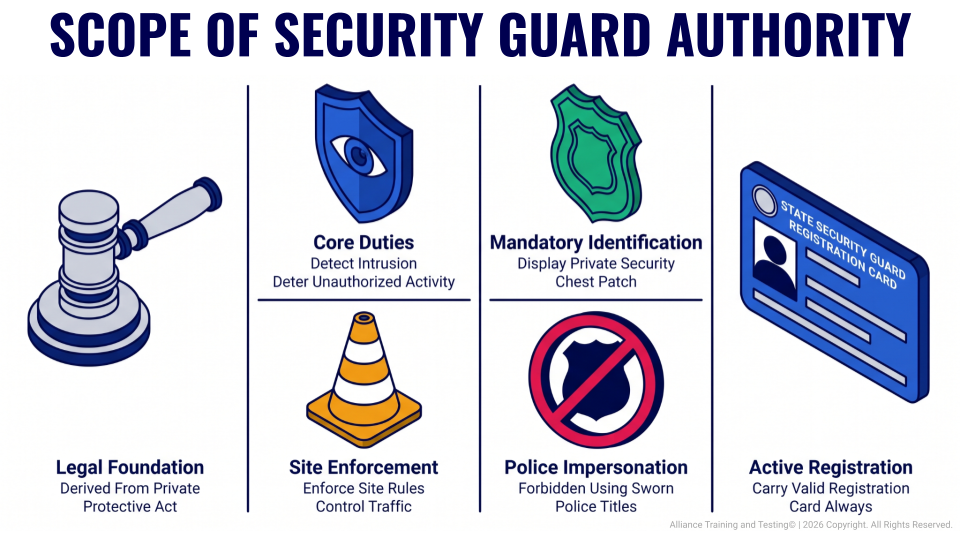
What Is the Exact Scope of a Security Guard's Authority in Tennessee?
A security officer's legal authority in Tennessee comes from the Private Protective Services Licensing and Regulatory Act (T.C.A. Title 62, Chapter 35) and is completely separate from the authority of a sworn police officer.
- Authorized Security Duties: Registered security guards are hired to protect people and property by:
- Preventing or detecting intrusion, unauthorized entry, theft, vandalism, abuse, fire, or trespass on private property.
- Observing, deterring, and reporting unauthorized activity on the premises.
- Enforcing property rules, company policies, and state or local laws on private property.
- Directing and controlling the flow of visitors and vehicles on private property.
- Strict Rules Against Impersonating Police: Tennessee law strictly forbids security officers from acting like, pretending to be, or implying they are sworn police officers or government officials. Badges, patches, uniforms, and vehicles cannot use the words "Police" or "Law Enforcement Officer." Furthermore, military or police-style uniforms must have a clear patch or insignia over the left breast pocket identifying the wearer as a private security officer.
- Carrying Your Registration Card on Duty: Every armed or unarmed security guard must keep their active state registration card (or valid pending application paperwork and payment receipt) on their person while on duty.
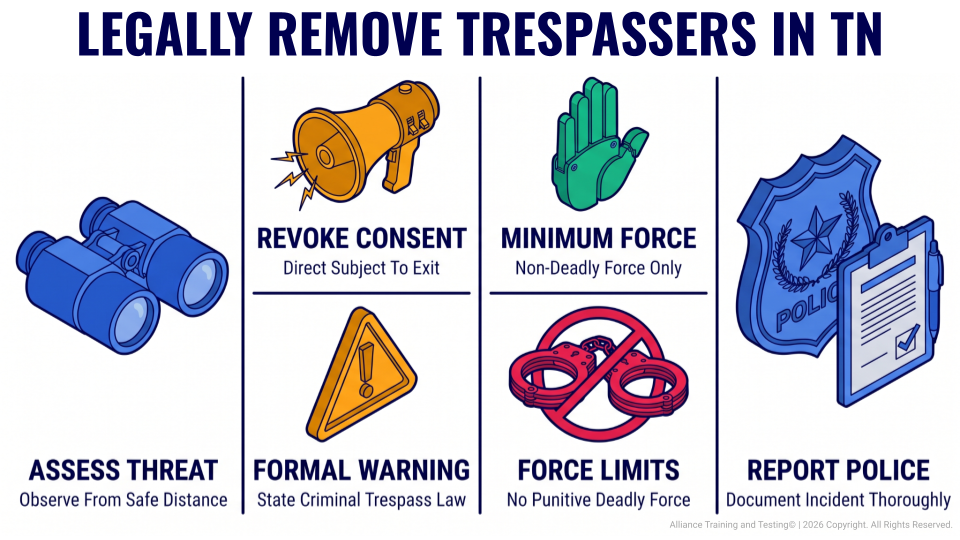
Step-by-Step Protocol: How to Legally Remove a Trespasser in Tennessee
When you encounter an unauthorized person on the property you protect, following a calm, step-by-step protocol keeps you safe and protects you and your employer from legal liability.
- Assess the Scene and Verify Threat Level: Before approaching, observe the person from a safe distance. Are they agitated, intoxicated, or visibly armed? If the situation looks dangerous, do not engage alone—maintain a safe perimeter and call local police immediately.
- Identify Yourself and Revoke Consent Verbally: Approach calmly while keeping a safe reactionary gap. Clearly identify yourself as private security representing the property owner, and politely ask the person to leave.
- Standard Verbal Script: "Hello, I am with property security representing the management. This area is restricted, and I need to ask you to exit the premises now."
- Issue a Formal Trespass Warning: If the person refuses to leave, give a firm, clear warning. Let them know that permission to be on the property has been revoked, remaining on the site is criminal trespass under Tennessee law, and the police will be called if they do not leave immediately.
- Follow Tennessee's "Protection of Property" Force Standard (T.C.A. § 39-11-614): Tennessee law allows a property owner or their authorized agent to use non-deadly force only when and to the degree reasonably believed immediately necessary to stop or end a trespass.
- Never Use Punitive Force: Force is strictly a last resort and can never be used to punish someone or "teach them a lesson."
- Strict Limits on Deadly Force: Deadly force is never legal to stop simple trespassing. In Tennessee, deadly force is only justified when you reasonably believe there is an imminent danger of death, serious bodily injury, or grave sexual abuse. In addition, legal justification never protects you if reckless force injures an innocent bystander.
- Contact Law Enforcement and Write a Detailed Report: When a trespasser refuses to comply with verbal warnings, calling local police is the safest and smartest move. Sworn officers have full arrest powers to remove the individual safely. Afterward, write a thorough incident report documenting the exact timeline, witness names, the warnings you gave, and the police response.
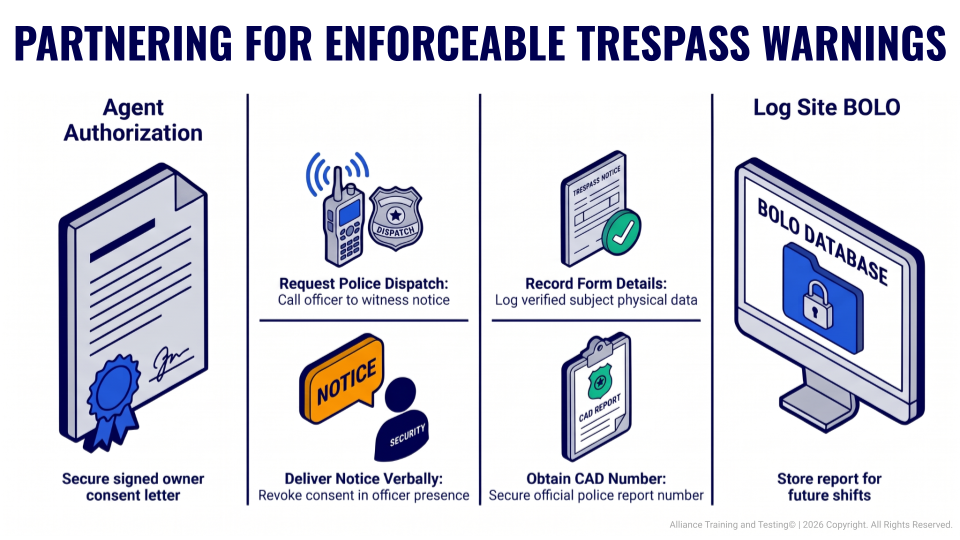
How to Partner with Local Law Enforcement to Issue a Legally Enforceable "Trespass Warning"
While a verbal warning from a security officer revokes consent in the moment, repeat offenders require an official, documented Trespass Warning (often called a Criminal Trespass Notice or Ban Notice) co-documented with local law enforcement. This creates an indisputable paper trail in court and gives responding police officers immediate probable cause to make a warrantless arrest (T.C.A. § 40-7-103) if the person returns.
- Establish Written "Agent Authorization" Before an Incident Occurs: Many Tennessee police departments and sheriff's offices require proof that security personnel have the property owner's legal authority to ban individuals and sign complaints. Ensure your post orders include a signed Trespass Enforcement Authorization Letter from the property owner or corporate management designating your security team as authorized agents.
- Request a Law Enforcement Dispatch to Witness the Warning: If an unauthorized or disruptive person refuses to leave—or if management wants a problematic individual permanently banned from the property—contact local police. Request that an officer respond to witness and issue an official Trespass Warning.
- Deliver the Notice in the Presence of the Responding Officer: When the police officer arrives, present your security registration card and inform the officer that you are acting as the property owner's agent. In the officer's presence, clearly state that their consent to be on the property is permanently revoked (or revoked for a specific timeframe) and that returning will result in immediate criminal prosecution for trespassing (T.C.A. § 39-14-405).
- Complete a Written Trespass Notice & Obtain the Police Event/CAD Number: Issue a written Trespass Warning form containing:
- The subject's full legal name, date of birth, and physical description (verified by the responding police officer, since subjects are not legally required to hand their ID to private security).
- The exact property address, date, time, and reason for the ban.
- The signature of the security officer/property manager and the name, badge number, and CAD/Incident Report Number of the witnessing police officer.
- Note whether the subject signed the notice or "Refused to Sign" in the police officer's presence.
- Log the Warning in the Site BOLO Database: Retain a copy of the Trespass Warning on-site, provide a copy to the client/property management, and log the police CAD number so future shifts can hand it directly to responding officers if the trespasser returns.
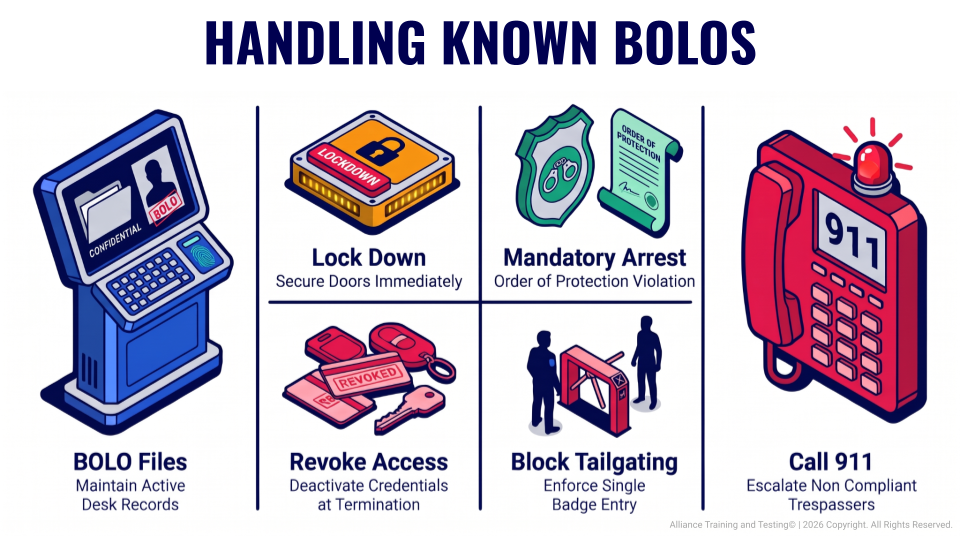
Handling Known BOLOs: Orders of Protection, Stalkers, and Terminated Employees
One of the highest-risk scenarios in private security is intercepting a known BOLO ("Be On the Lookout") subject—such as an estranged spouse under a court-issued Order of Protection or a recently terminated, disgruntled employee attempting to breach an access-controlled facility.
1. Dealing with Ex-Spouses, Domestic Abusers, and Orders of Protection
When an employee or tenant notifies security that an ex-spouse or stalker has an active Order of Protection, court order of no contact, or restraining order prohibiting them from entering the workplace or residence:
- Maintain Actionable BOLO Profiles at the Access Control Desk: Keep a confidential BOLO file at the security desk containing a recent photograph of the restricted individual, their vehicle make/model/license plate, and a copy of the active Order of Protection or no-contact bail condition.
- Deny Entry & Lock Down Access Points Immediately: If the restricted individual is spotted approaching or attempting to enter, immediately lock down electronic access doors/gates and notify the targeted employee or resident to move to a secure interior room.
- Call 911 Immediately (Mandatory Warrantless Arrest Authority): Do not treat an Order of Protection violation as a routine trespass. Under Tennessee law (T.C.A. § 40-7-103(a)(7), (9), and (b)), sworn law enforcement officers have specific statutory authority—and in many domestic violence or release-condition violations, a mandatory duty—to arrest the offender without a warrant when they have probable cause to believe the person violated an Order of Protection, committed stalking, or breached no-contact bail conditions.
- Critical Legal Note on Workplace/Residence Defense (T.C.A. § 39-11-611(c)-(d)): Under Tennessee's self-defense statute, a person who unlawfully and forcibly enters a business or residence creates a legal presumption of imminent danger. While this presumption normally does not apply against a lawful co-owner or resident, Tennessee law explicitly states that the protection does apply if that person is prohibited from entering the business, residence, or vehicle by an Order of Protection, domestic abuse injunction, or court order of no contact. Even so, security officers should prioritize physical barriers, lockdown protocols, and immediate police intervention over physical confrontation.
2. Intercepting Terminated Employees at Access-Controlled Facilities
When an employee is terminated—especially following a workplace dispute or disciplinary action—their effective consent to enter the property is permanently revoked.
- Coordinate Pre-Termination Access Revocation: Security should work with Human Resources and IT to ensure the terminated employee's keycards, fobs, PIN codes, and parking passes are deactivated the exact moment termination occurs.
- Watch for "Tailgating" and "Piggybacking": Terminated employees often attempt to bypass access control by following authorized coworkers through secure doors or claiming they "forgot their badge" and just need to grab personal items. Train guards and staff never to hold secure doors open for anyone without an active badge scan.
- Use Calm, Non-Confrontational Interception: If a terminated employee attempts to enter a lobby or gate, keep the physical barrier between you and the individual. State calmly: "Your access credentials are no longer active, and management requires all post-employment business to be scheduled through Human Resources. I cannot permit you past this point, and I can provide you with HR's contact number."
- Escort & Property Retrieval Protocols: Never allow a terminated employee to wander unescorted to their former desk or locker. Either have HR bring their boxed personal belongings to the lobby, or require a scheduled, security-escorted retrieval approved by management.
- Escalate to Police if They Refuse to Depart: Once a terminated employee is told they are not permitted past access control, any refusal to leave or attempt to force past a turnstile or door constitutes criminal trespass (T.C.A. § 39-14-405). Do not use handcuffs or attempt to physically detain them; secure the interior doors, maintain visual observation via CCTV, and call local police to remove and formally trespass the individual.
Tennessee Statutory Comparison: Legal Standards for Security Officers
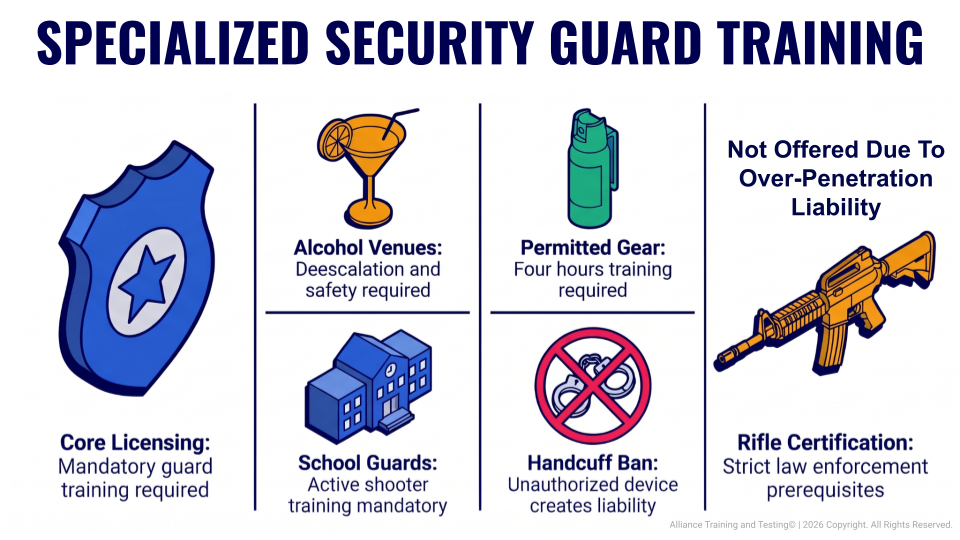
Specialized Post & Weapon Training Requirements in Tennessee (2026 Updates)
To legally enforce property rights without exposing yourself or your employer to costly lawsuits (Tennessee requires security employers to carry at least $300,000 in bodily/personal injury—including false arrest endorsements—and $100,000 in property damage liability insurance), security guards must hold the right state certifications for their post and gear:
- Core Unarmed & Armed Licensing (T.C.A. § 62-35-118): Every guard must complete at least 4 hours of general training (covering Orientation, Legal Powers and Limitations, Emergency Procedures, and General Duties) within 15 days of hire. Armed guards must be at least 21 years old and complete 8 hours of classroom firearms training plus 4 hours of range marksmanship training (scoring at least 70% accuracy) within 60 days. All firearm classroom and range training must be completed in person.
- Bars, Restaurants, and Alcohol-Serving Venues: Any armed or unarmed guard working at a venue licensed for on-premises alcohol consumption must apply to add specialized classifications to their registration card before working the post. Within 15 days, the guard must complete certified training in De-escalation Techniques, Proper and Safe Restraint Techniques, First Aid, and CPR (at least 1 hour each). Alcohol venues that directly hire unregistered guards face a mandatory 1-month alcohol license suspension per violation.
- Public, Charter, Private, and Church-Related Schools: Security guards must finish all required state training before being posted at any school. Armed guards working in schools must also complete at least 8 hours of in-person Active Shooter Training prior to starting work at the school.
- Less-Than-Lethal Weapons & Unauthorized Devices: Under Tennessee Private Protective Services rules, a security guard may carry a baton, chemical spray, or stun gun only after completing at least 4 hours of training per device with a state-certified trainer, getting authorization from their employer, and carrying the signed weapon certification card on duty. Note on Handcuffs: Tennessee Private Protective Services does not recognize handcuffs as an authorized security device. Even with outside training, using handcuffs on duty exposes a guard to heightened criminal and civil liability—including false arrest, false imprisonment, assault, and battery.
- Enhanced Armed Guard Certification (Rifles & Shotguns): Under Tennessee's 2026 regulations (T.C.A. § 62-35-144), no security officer may carry a rifle or shotgun on duty without an active Enhanced Armed Guard registration. Applicants must have at least 5 years of full-time law enforcement experience or 4 years of military combat arms experience, pass FBI/TBI fingerprint checks and a psychological exam, and complete a 16-hour in-person training and live-fire qualification course.
Why Alliance Training and Testing Will Not Offer the Enhanced Armed Guard Rifle Certification
While state law now permits this classification, Alliance Training and Testing has taken a firm, safety-first stand and will not offer the Enhanced Armed Guard rifle program. Based on a rigorous risk and liability audit by our Certified Protection Professional (CPP) leadership, deploying long guns in routine private security is an untenable risk:
- Catastrophic Liability & Over-Penetration: Security officers work in close-quarters environments—retail aisles, hospitals, schools, and office hallways. High-velocity 5.56 rifle rounds (traveling at 2,900–3,100 fps) easily penetrate multiple layers of drywall and building materials, creating an unacceptable risk of collateral injury or death to innocent bystanders (where Tennessee's civil immunity protections under T.C.A. § 39-11-622 do not apply).
- Lack of Qualified Contract Security Company Oversight: Safely deploying rifles requires extensive law-enforcement-grade infrastructure, strict tactical supervision, and verified secure storage protocols that most private contract security companies are not equipped to manage.
- Strictly Limited Applicant Pool: Because state law restricts eligibility to candidates with 5+ years of full-time law enforcement or 4+ years of military combat arms experience, most working Tennessee security guards do not qualify.
Instead of endorsing a high-liability long-gun program, we focus on advanced, reality-based handgun mastery, de-escalation, and state-mandated certifications that genuinely protect officers and the public. (Read our full risk audit here: Why Alliance Training & Testing Will Not Offer the Tennessee Enhanced Armed Guard Rifle Certification)
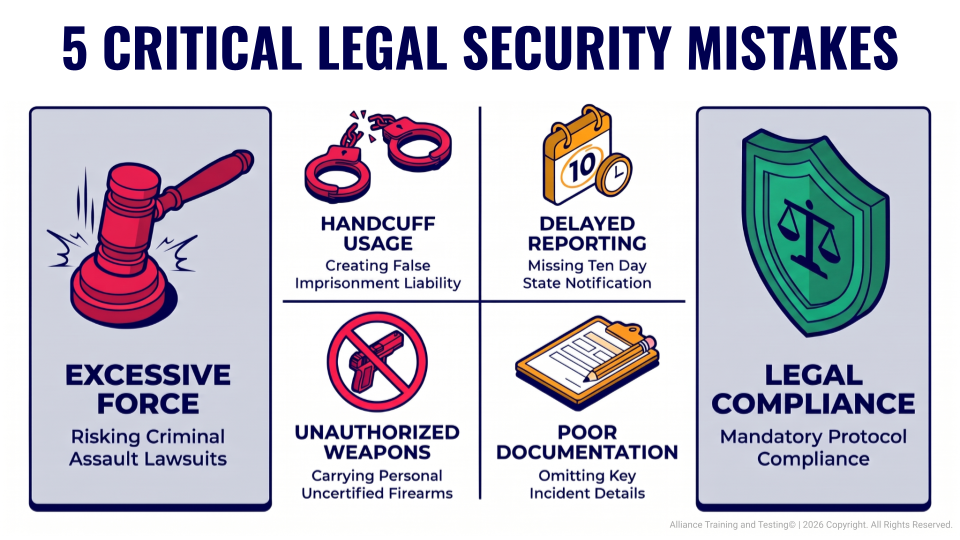
5 Critical Legal Mistakes Security Officers Must Avoid
- Using Excessive Force: Using more force than is immediately necessary to remove a trespasser strips away your civil liability protection and opens you and your company up to criminal assault charges and lawsuits.
- Using Handcuffs, Unlawful Detention, and False Imprisonment: Tennessee Private Protective Services does not recognize handcuffs as an authorized security device. Even if a guard has completed outside handcuffing courses, using handcuffs on a trespasser or subject carries severe legal liability—including criminal charges and civil lawsuits for false arrest, false imprisonment, assault, and battery.
- Carrying Unauthorized Weapons on Duty: Under Tennessee state rules, you cannot carry any weapon not explicitly provided for by state rules, nor can you carry a personal firearm while working as a security guard—even if you have a personal handgun carry permit—unless you hold an active Armed Security Guard registration card and are certified for that exact firearm.
- Failing to Report Arrests or Orders of Protection Within 10 Days: Tennessee law requires both the security officer and their employer to notify the state in writing within 10 days of any arrest, citation, or conviction for a disqualifying crime (such as assault and battery, theft, shoplifting, stalking, or weapons charges) or any Order of Protection or bond condition restricting firearm possession.
- Failing to Document the Incident: In the legal world, if it isn't written down, it didn't happen. Leaving out witness names, the exact time of your verbal warnings, or details about the responding police officer makes it much harder to defend your actions in court.
Frequently Asked Questions
Can a security guard in Tennessee use handcuffs on a trespasser?
No. Tennessee Private Protective Services does not recognize handcuffs as an authorized security device under state rules (which only authorize certified firearms, batons, chemical spray, and stun guns). Therefore, even if a security officer has prior training or qualifications, using handcuffs on duty creates severe legal exposure—including criminal and civil liability for false arrest, false imprisonment, assault, and battery, as well as any other civil charges that may be appropriate. Security guards should rely on verbal de-escalation and contact sworn law enforcement officers to handle physical arrests and restraints.
How do security guards and police issue a formal "Trespass Warning" in Tennessee?
To issue a legally enforceable Trespass Warning that holds up in court, a security guard (acting with written agent authorization from the property owner) should call local police to the scene when an unauthorized person refuses to leave or needs to be permanently banned. In the presence of the responding police officer, the guard revokes the subject's consent to be on the property and issues a written Trespass Notice. The police officer verifies the subject's identity and logs the warning under an official police CAD/incident number, giving law enforcement immediate probable cause to arrest the subject for criminal trespass (T.C.A. § 39-14-405) if they ever return.
How should a security officer handle a BOLO for an ex-spouse with an Order of Protection or a terminated employee?
Security officers should maintain updated BOLO ("Be On the Lookout") records at access control points, ensure terminated employees' keycards are immediately deactivated, and keep physical barriers (locked doors, turnstiles, or gates) between the subject and the facility interior. If a subject with an active Order of Protection appears on site, secure the facility and call 911 immediately—Tennessee law (T.C.A. § 40-7-103) empowers police to make an immediate warrantless arrest for Order of Protection, stalking, or domestic violence violations. If a terminated employee attempts to re-enter, calmly deny access, never allow unescorted entry, and contact police if they refuse to leave.
What is the difference between criminal trespass and aggravated criminal trespass in Tennessee?
Simple criminal trespass (T.C.A. § 39-14-405) happens when someone knowingly enters or stays on property without the owner's consent. Aggravated criminal trespass (T.C.A. § 39-14-406) is a more serious charge that applies when a trespasser knows they do not have permission to be there and either intends or knows their presence will cause someone to fear for their safety, or when they trespass inside a home, school, or other sensitive property.
Does Tennessee law require a "No Trespassing" sign to enforce trespassing laws?
No. While a clearly posted "No Trespassing" sign is great evidence for court, Tennessee law also recognizes fences, physical barriers, and direct verbal warnings from a property owner or security guard as legal notice that someone is not allowed on the property.
Are Tennessee security guards protected from civil lawsuits when using lawful force?
Yes, under T.C.A. § 39-11-622, if a security officer uses lawful, justified force to defend themselves, protect another person, or terminate a trespass on property, Tennessee law provides immunity from civil lawsuits brought by the aggressor—and even allows the court to award attorney's fees and court costs if you are sued. However, this civil immunity does not apply if force is used against an identified police officer, if reckless force injures an innocent bystander, or if the guard uses unauthorized devices or unlawful restraint.
What should a Tennessee security officer include in a trespassing incident report?
A strong incident report should state: (1) the date, time, and exact location of the event; (2) a clear physical and clothing description of the trespasser; (3) the exact time and wording of your verbal warnings asking them to leave; (4) a step-by-step account of what was said and done by everyone involved; (5) names and contact info for any witnesses; and (6) the responding police department, officer names, badge numbers, CAD/incident number, and final outcome.
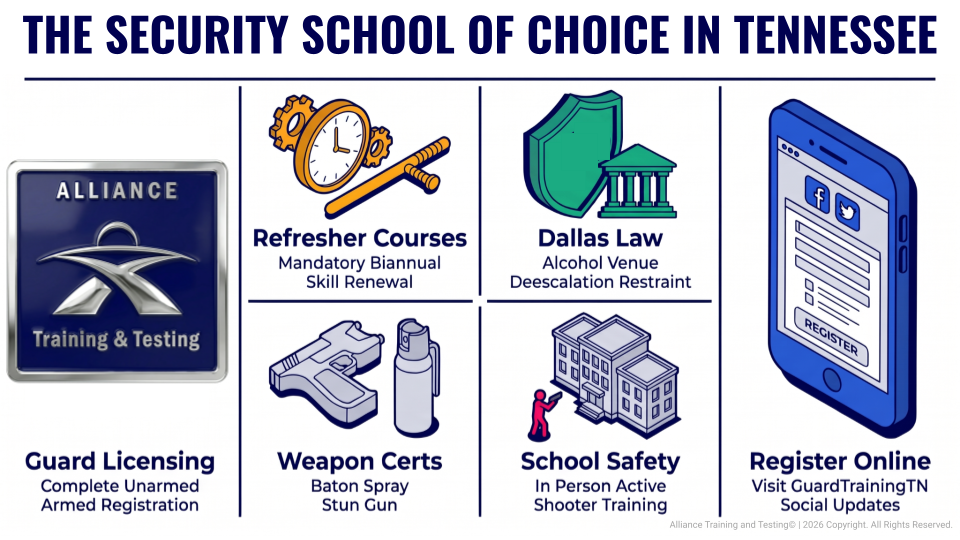
Train with the Security School of Choice in Tennessee
Mastering Tennessee's trespassing laws, access control protocols, use-of-force boundaries, and state licensing rules is essential to protecting your career, your license, and the properties you guard. Whether you need Unarmed or Armed Security Guard Registration, Biannual Refresher Training, Alcohol Venue De-Escalation & Restraint Certifications (Dallas's Law), School Active Shooter Training, or Less-Than-Lethal Weapon Certifications, train with Alliance Training and Testing (@GuardTrainingTN) — The Security School of Choice in Tennessee.
Explore Courses: guardtrainingtn.com
Register Online:| securityguardlicensetn.com
Follow for Daily TN Security Law & Training Updates: @GuardTrainingTN
Can Security Guards Use Handcuffs or Force on Trespassers in TN? @guardtrainingtn