
Security Guard Report Writing: The 5 W's Framework & Best Practices 🛡️ @guardtrainingtn
In professional physical security, your most powerful tool isn't always a flashlight, radio, or access control system—it's a pen (or, increasingly, a tablet). A well-written report can be the critical piece of evidence that helps solve a crime, prevents a future incident, or protects your company from liability.
But for many new officers, writing a clear, concise, and professional report can feel daunting. An incomplete or poorly written report is more than just bad paperwork; it can undermine an active investigation, compromise legal proceedings, and reflect poorly on your professionalism.
This guide is your complete introduction to mastering the art of the security report. You will learn the foundational principles of the 5 Ws, how to gather facts like a detective, and the golden rule of maintaining strict objectivity.
Why is Effective Report Writing Crucial for Security Guards?
Before diving into how to write a security report, it's vital to understand why we write them. A security report is a formal, official document that serves four essential functions:
- Creates a permanent record: Your report documents an event and provides a detailed account that can be referenced days, months, or even years later.
- Informs key stakeholders: Supervisors, clients, law enforcement, and legal teams rely on your reports to understand what happened and dictate next steps.
- Serves as legal evidence: In the event of a lawsuit or criminal trial, your incident report can be subpoenaed and scrutinized in court. A clear, factual report is a lawyer’s best friend.
- Identifies threat patterns: A collection of well-documented reports—such as your Security Officer Daily Activity Report (DAR)—helps management identify vulnerabilities, track maintenance issues, or spot recurring suspicious activity.
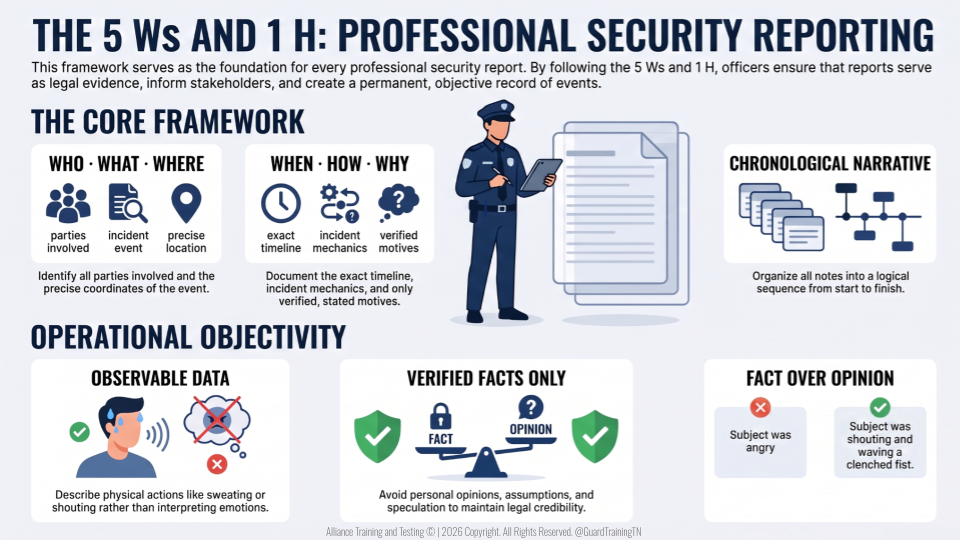
The Foundation of Every Great Report: The 5 Ws & 1 H
The 5 Ws and 1 H are the building blocks of any comprehensive incident report. Answering these questions ensures you cover all essential details and leaves no room for ambiguity.
Who: Identifying All Parties
Clearly identify every person involved. This isn't just about suspects and victims.
- Who was involved? (Suspects, victims, witnesses)
- Who reported the incident?
- Who responded to the scene? (Other guards, local police, paramedics)
Pro Tip: Be as specific as possible. Use full names, job titles, and contact information. For unknown individuals, provide detailed physical descriptions (height, build, hair color, clothing, distinguishing marks).
What: Describing the Incident
This is the core of your report. Describe exactly what happened in a clear, chronological sequence.
- What event occurred? (e.g., theft, vandalism, medical emergency, access control breach)
- What actions were taken? (By you, and by others)
- What was the outcome? (e.g., suspect apprehended, area secured, victim transported to hospital)
Where: Pinpointing the Location
Context is key. Be precise about the incident's physical location.
- Where exactly did it happen? Use specific addresses, room numbers, or landmarks (e.g., "The northeast corner of the parking garage, level 3, near stairwell B").
- Where were the witnesses, victims, and suspects located relative to the incident?
When: Establishing the Timeline
A precise timeline is crucial for any investigation, especially when reviewing CCTV footage later.
- When did you receive the call or notice the issue?
- When did you arrive on the scene?
- When did the incident itself occur?
- When did other responders arrive?
- When was the scene cleared?
Why: Understanding the Motive (With Caution)
This is the trickiest of the Ws. While you might have a theory, your job is to report facts, not speculate.
- Only state the "why" if it is a known fact. (e.g., "The suspect stated he broke the window because he was locked out of his car.")
- Never guess. Do not write, "I think the suspect broke the window because he was angry." Stick strictly to what you know.
How: Detailing the Mechanics
"How" describes the mechanics of the incident from start to finish.
- How did the suspect gain entry? (e.g., forced the door, tailgated an employee)
- How was the victim injured?
- How was the situation brought under control?
The Golden Rule: Maintaining Objectivity
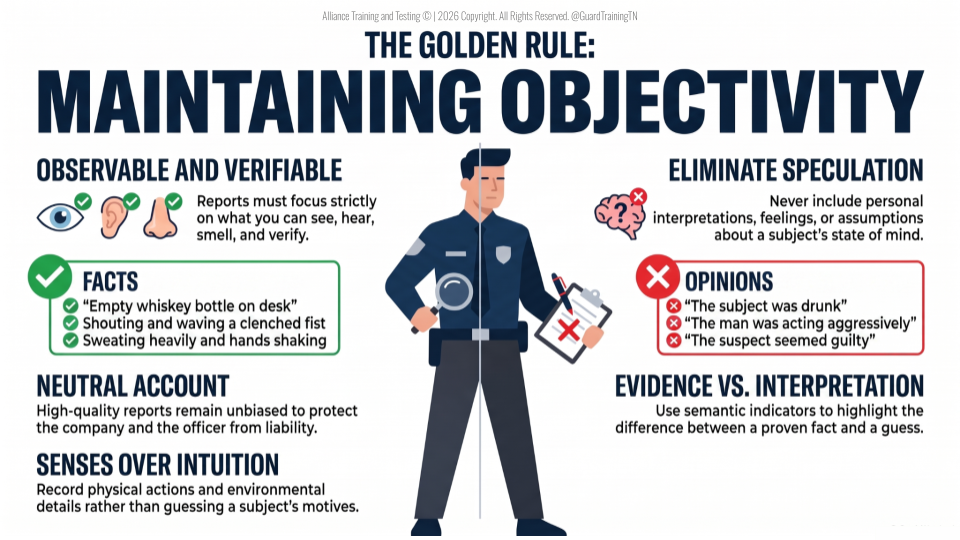
The single most important quality of a security report is objectivity. Your report must be a neutral, unbiased account. It should be free from personal feelings, opinions, assumptions, and emotional language.
Facts vs. Opinions: Knowing the Difference
Learning how to write a security report professionally means mastering the distinction between an observable fact and a personal interpretation.
Always stick to what you can see, hear, smell, and verify. Let the reader of the report draw their own conclusions based on the hard facts you provide.

The Art of Gathering Facts at the Scene
Effective incident report writing for security begins long before you open your reporting software or uncap your pen. It starts with a methodical approach to managing the scene.
- Secure the Scene: Safety and preservation first. Your first priority is safety. Secure the area, provide first aid if necessary, and call for backup or emergency services if needed. Once safe, preserve any physical evidence.
- Observe and Take Notes: Do not rely on memory. Use all your senses. What do you see, hear, or smell? Write everything down in your pocket notebook immediately. Note the weather, lighting conditions, and the exact state of the scene when you arrive.
- Interview Witnesses: Keep Them Separated. Speak to everyone involved separately, so they don't influence each other's memories. Ask open-ended questions to encourage detailed responses. Record their statements accurately, using direct quotes when appropriate.
- Draft the Report: Use a chronological structure. Organize your notes into a logical format. Start with a brief introduction (the summary of the event), move to a detailed chronological narrative in the body, and end with a conclusion detailing the final outcome and actions taken.
Conclusion
Mastering security guard report writing is a non-negotiable skill for any serious professional in the physical security industry. It is the final, crucial step in handling any incident. By consistently applying the 5 Ws, remaining strictly objective, and following a structured fact-gathering process, you ensure your reports are credible, legally sound, and highly professional.
Remember, your report acts as your voice long after you've left the scene. Make sure it speaks with clarity, accuracy, and integrity.
Frequently Asked Questions
1. What is the most important part of a security report?
The most important part of any security report is objectivity. A report must be a factual, unbiased account of events. Without objectivity, the report's credibility is compromised, and it may be deemed useless for legal, HR, or investigative purposes.
2. How can I make my security reports more professional?
Use clear and concise language, check for proper grammar and spelling, and avoid street slang or overly complex jargon. Stick strictly to the facts, organize your information chronologically, and ensure you've answered the 5 Ws (Who, What, Where, When, Why) and 1 H (How).
3. Should I include my personal opinions in an incident report?
No. You should never include personal opinions, assumptions, or speculations. Your job is to report only observable facts. For example, instead of writing "The suspect seemed nervous," describe the actual physical actions: "The suspect was sweating, avoiding eye contact, and his hands were visibly shaking."
4. What's the difference between a Daily Activity Report (DAR) and an Incident Report?
A Security Officer Daily Activity Report (DAR) is a chronological summary of all routine activities during a shift, including regular patrols, maintenance checks, and minor occurrences. An Incident Report is a dedicated, highly detailed document created in response to a specific, unusual event, such as a theft, medical emergency, or physical altercation.
The Legal Time Capsule - Writing Airtight Security Reports @GuardTrainingTN